


What's Happening?
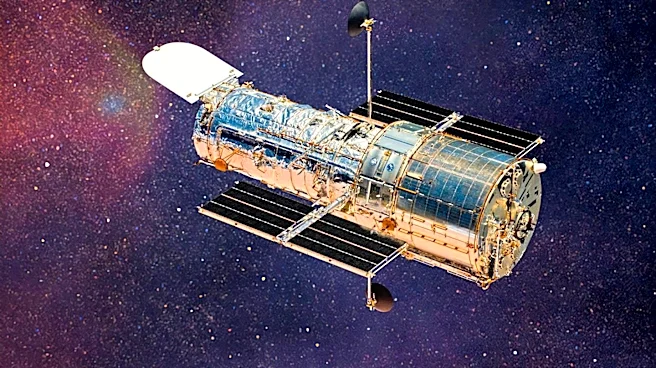
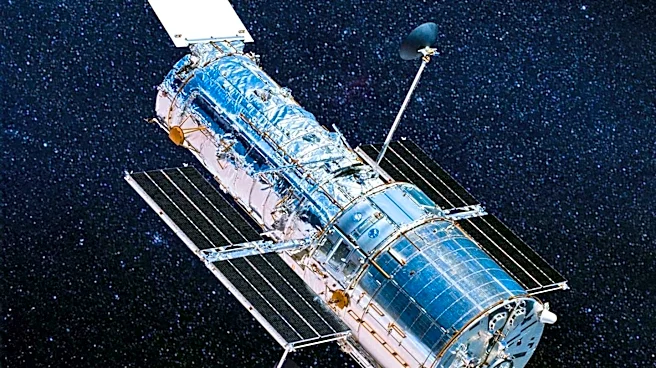
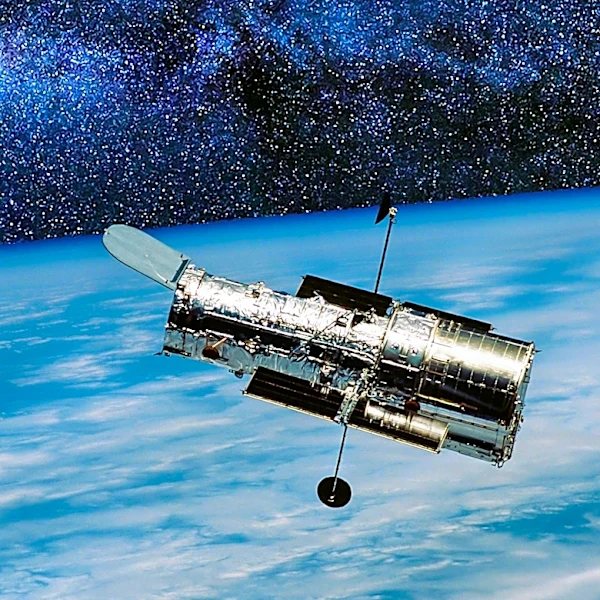
The Hubble Space Telescope remains a crucial instrument for astronomical research, providing detailed observations of distant galaxies. It has captured images of galaxies in collision, such as Arp-Madore 417-391, which is approximately 670 million light-years
away from Earth. The telescope's capabilities allow astronomers to study the shape, structure, and evolution of these celestial bodies. Despite its age, Hubble continues to make significant discoveries, rivaling those of historical scientific instruments. Its observations contribute to a deeper understanding of the universe, including phenomena like gravitational lensing, where the gravity of a foreground object warps spacetime and magnifies light from background galaxies. These images are not only scientifically valuable but also visually stunning, offering a 'visual feast' of the cosmos.
Why It's Important?
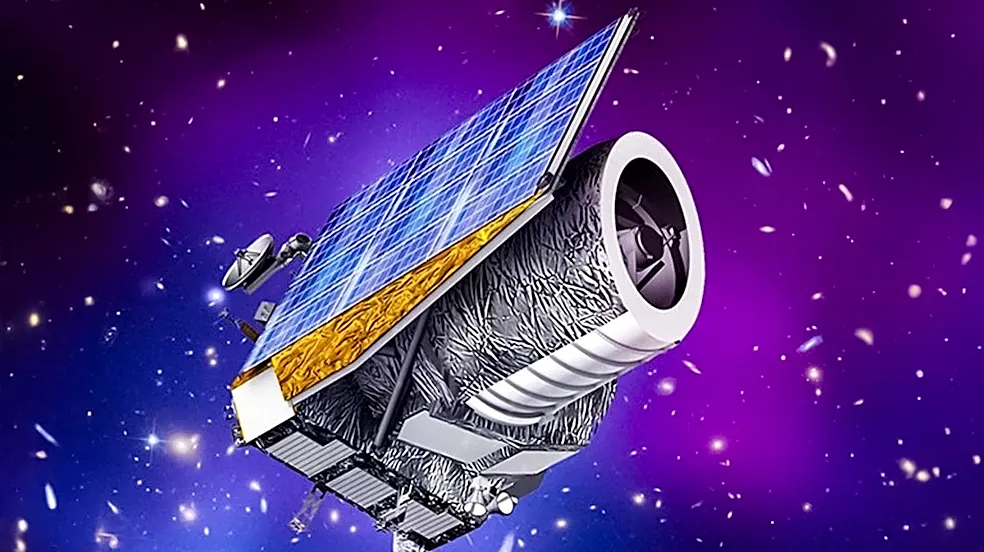
The ongoing operation and data collection by the Hubble Space Telescope are vital for advancing humanity's understanding of the universe. Its ability to capture high-resolution images of distant galaxies and phenomena like gravitational lensing provides critical data for astronomers studying cosmic evolution, dark matter, and the fundamental forces shaping the universe. The insights gained from Hubble's observations directly influence theoretical models and future space missions. For instance, its current work on gravitational lenses is preparing for the capabilities of the upcoming Nancy Grace Roman Space Telescope, which will have a much wider field of view. This collaboration between current and future missions ensures a continuous and expanding exploration of space, impacting scientific research and inspiring public interest in astronomy.
What's Next?
The data collected by the Hubble Space Telescope is actively being used to prepare for future missions, particularly the Nancy Grace Roman Space Telescope. Hubble's observations of gravitational lenses are crucial for developing tools and models to analyze the vast amounts of data Roman is expected to collect. While Hubble can view these lenses one at a time, Roman's wide field of view will allow for the detection of a greater sample. Astronomers are using Hubble's sharp images to build computer models to better analyze dark matter-induced distortions, which will aid in interpreting Roman's large images. Furthermore, Hubble will continue to follow up on interesting lenses detected by Roman, demonstrating a synergistic approach to cosmic exploration.
Beyond the Headlines
The Hubble Space Telescope's enduring legacy extends beyond scientific data; it has profoundly influenced public perception and engagement with space. Described as the 'most important scientific instrument ever built,' Hubble's breathtaking images have made complex astronomical concepts accessible and inspiring to a global audience. The process of colorizing Hubble's images, which are initially captured in shades of gray, involves scientific interpretation and artistic rendering to highlight specific wavelengths and elements, making the invisible visible and comprehensible. This blend of science and art fosters a deeper appreciation for the cosmos and encourages STEM education. The telescope's contributions have not only expanded scientific knowledge but also enriched cultural understanding of our place in the universe.