









What's Happening?
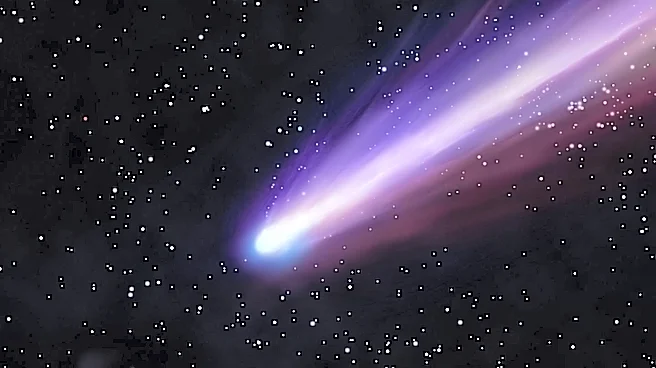
A meteorite that crashed into a New Jersey home two years ago has been found to contain 'extraterrestrial' amino acids, according to a study published in Science Advances. The meteorite, weighing over 2 pounds, was observed as a fireball across several
states before it fragmented and landed in Hillsborough, New Jersey. Researchers from NASA's Goddard Space Flight Center and the SETI Institute analyzed the meteorite, identifying a complex suite of amino acids, many of which are rare or nonexistent on Earth. This discovery provides insights into the early solar system and the potential for life-supporting molecules to form in space.
Why It's Important?
The findings from the Hillsborough meteorite are significant as they offer a rare glimpse into the chemical processes that may have contributed to the origin of life on Earth. The presence of amino acids, the building blocks of proteins, in the meteorite suggests that such organic compounds could have been delivered to Earth via meteorites, supporting theories about the extraterrestrial origins of life's building blocks. This research enhances our understanding of the solar system's history and the potential for life elsewhere in the universe.
What's Next?
Researchers are continuing to study the Hillsborough meteorite to identify the salt minerals present and compare them with samples from other asteroids. These efforts aim to further understand the conditions and processes that could lead to the formation of life-supporting molecules in space. The meteorite fragments are being preserved at the American Museum of Natural History for ongoing and future research.