
What's Happening?
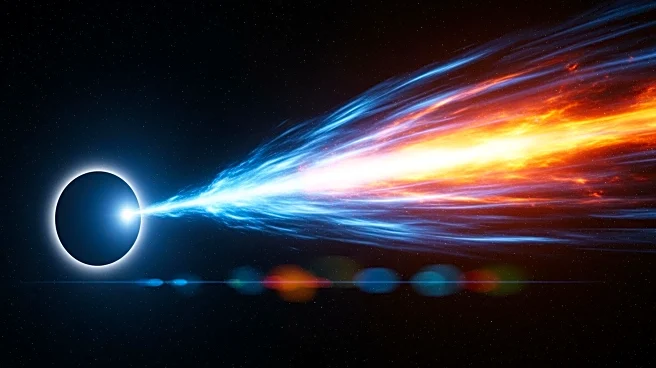
Astronomers have successfully traced a massive, 3,000-light-year-long jet of charged particles back to its origin at the supermassive black hole M87, using the Event Horizon Telescope. This breakthrough
provides a clearer understanding of how black holes can launch matter across the universe at nearly the speed of light. M87, located 55 million light-years away in the Messier 87 galaxy, is a supermassive black hole with a mass 6.5 billion times that of the Sun. The study utilized Very Long Baseline Interferometry to analyze observations from 2021, allowing scientists to pinpoint where the jet erupts from the black hole's surroundings. This discovery is a significant step in understanding the mechanics of black hole jets.
Why It's Important?
This discovery is crucial for astrophysics as it provides insights into the mechanics of black hole jets, which are among the most powerful phenomena in the universe. Understanding these jets can help scientists learn more about the role of black holes in galaxy formation and evolution. The ability to trace the jet back to its source also bridges the gap between theoretical models and direct observations, enhancing our understanding of how these cosmic engines operate. This knowledge could lead to advancements in our understanding of the universe's structure and the fundamental processes that govern it.
What's Next?
The Event Horizon Telescope team plans to capture higher-resolution data to create 'movies' that track the jet's movement and internal structure in real-time. These observations will allow scientists to see how the jets interact with their surroundings, providing further insights into the impact of supermassive black holes on their host galaxies. This ongoing research could lead to new discoveries about the dynamics of black holes and their influence on the cosmos.