



What's Happening?
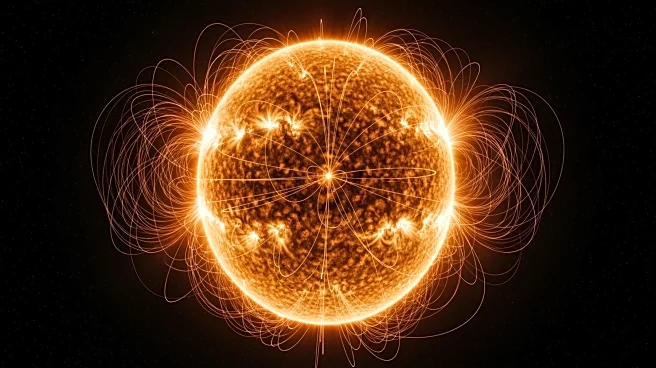
NASA's Parker Solar Probe has successfully mapped the sun's Alfvén surface, a critical boundary in the sun's outer atmosphere, for the first time. This boundary marks the point beyond which solar particles are swept into the solar wind, a stream of charged
particles flowing from the sun. The probe, which has been operating since 2021, is the first spacecraft to fly so close to a star, thanks to its advanced heat shield capable of withstanding extreme temperatures. The new 2D maps reveal that the Alfvén surface changes shape and becomes more turbulent as the sun's activity increases, particularly during its 11-year solar cycle. This mapping was achieved using data from the probe's Solar Wind Electrons Alphas and Protons instrument, providing unprecedented detail about the sun's outer atmosphere.
Why It's Important?
The mapping of the Alfvén surface is significant for understanding solar wind behavior and its impact on Earth. Solar flares, which are more frequent during the sun's active periods, can disrupt technologies such as GPS, communication systems, and power grids. By predicting the occurrence and strength of solar flares, scientists can help mitigate potential disruptions to these critical systems. The Parker Solar Probe's findings enhance our ability to forecast space weather, which is crucial for protecting technological infrastructure on Earth. This research also contributes to the broader understanding of solar dynamics and their influence on the solar system.
What's Next?
Although the Parker Solar Probe's primary mission has concluded, the spacecraft remains operational and will continue to collect data until at least mid-2029. Future flybys will likely provide additional insights into the sun's behavior and further refine our understanding of the Alfvén surface. Continued observations will help improve space weather prediction models, offering better protection for Earth's technological systems. The ongoing data collection will also support future missions and research focused on solar and space weather phenomena.