



What's Happening?
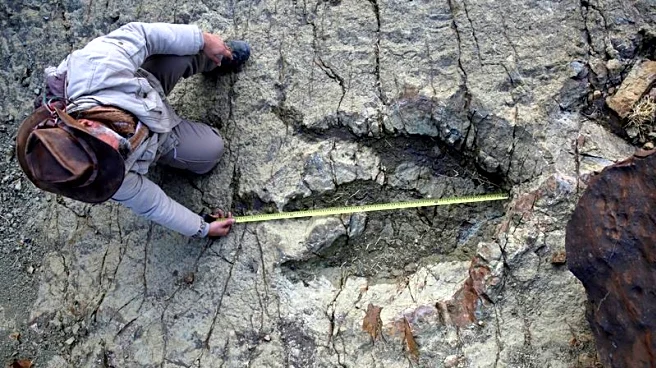
An international team of scientists, led by Timothy Bromage from NYU College of Dentistry, has successfully recovered metabolic molecules from fossilized bones dating back up to three million years. This groundbreaking study, published in Nature, utilized
mass spectrometry to analyze fossils from Tanzania, Malawi, and South Africa, revealing thousands of metabolites. These findings provide a biochemical snapshot of ancient environments, offering insights into the diets, health, and diseases of prehistoric animals. The research marks a significant advancement in paleontology, allowing for a more detailed reconstruction of ancient ecosystems.
Why It's Important?
The ability to analyze metabolites in fossilized bones represents a major leap in understanding prehistoric life. This method provides a multi-dimensional profile of ancient animals, revealing details about their diets, health, and environmental conditions. The discovery of disease markers, such as the Trypanosoma brucei parasite in a 1.8-million-year-old squirrel bone, offers new insights into the evolution of host-pathogen dynamics. This research enhances our understanding of ancient ecosystems and could inform studies on climate change and biodiversity.
What's Next?
The research team plans to expand their studies to include more fossil samples, aiming to reconstruct ancient environments with greater precision. This approach could revolutionize paleo-ecology by providing detailed insights into the climatic and ecological conditions of prehistoric times. The integration of paleontology, chemistry, and ecology may lead to new discoveries about the evolution of life on Earth.