







What's Happening?
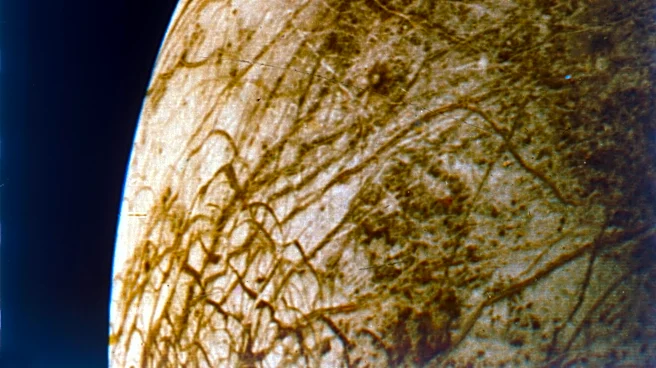
Researchers from Washington State University have proposed a model suggesting that Europa's surface ice, rich in oxidants, could become dense enough to sink through the moon's ice shell, potentially delivering life-supporting chemistry to its subsurface
ocean. This model, published in The Planetary Science Journal, indicates that under favorable conditions, this process could begin in as little as 30,000 years. The study addresses the challenge of how surface-produced oxidants, which could serve as chemical energy sources, might reach the ocean beneath Europa's thick ice shell.
Why It's Important?
This research is significant as it offers a potential mechanism for delivering essential chemical ingredients to Europa's ocean, which is considered a prime candidate for extraterrestrial life. Understanding how surface chemistry interacts with the ocean could provide insights into the moon's habitability. The findings could influence future missions, such as NASA's Europa Clipper, which aims to explore the moon's ice shell and ocean to assess its potential for supporting life.
What's Next?
NASA's Europa Clipper mission, set to arrive in the Jupiter system in 2030, will investigate Europa's ice shell and ocean to determine their potential for supporting life. The mission will use various instruments to study the moon's surface composition, ice shell structure, and potential subsurface ocean. The data collected could validate or refine the proposed model, enhancing our understanding of Europa's habitability and guiding future exploration efforts.