




What's Happening?
The U.S. House of Representatives has passed the Illegal Red Snapper and Tuna Enforcement Act, sending it to President Trump for his signature. The bill, which originated in the U.S. Senate in January 2025 and passed there in July 2025, aims to combat
illegal, unreported, and unregulated (IUU) fishing. A key provision of the legislation directs the National Oceanic and Atmospheric Administration (NOAA) and the National Institute of Standards and Technology (NIST) to collaborate on developing a field test kit. This kit will be capable of identifying the country of origin of seafood through chemical analysis, specifically focusing on red snapper and tuna during pilot studies. U.S. Senator Brian Schatz (D-Hawai'i) emphasized that the bill will help prevent consumers from being misled by mislabeled seafood and support law-abiding U.S. fishermen.
Why It's Important?
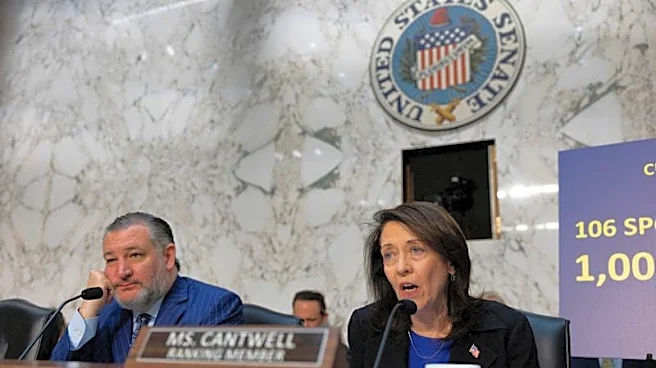
This legislation is crucial for several reasons. Firstly, it addresses the economic impact of IUU fishing, which U.S. Senator Brian Schatz noted 'rips off consumers and makes it harder for law-abiding U.S. fishermen to compete.' The ability to accurately identify seafood origin will protect consumers from fraudulent products and ensure fair competition for domestic fisheries. Secondly, the bill aims to disrupt criminal activities, as U.S. Senator Ted Cruz (R-Texas) highlighted that 'Cartels and other criminal entities are illegally catching, importing, and selling red snapper and tuna to unwitting consumers and then using such profits to fund other illicit activities like drug smuggling and human trafficking.' By targeting the financial streams of these illicit operations, the act contributes to broader national security efforts. Lastly, it strengthens international cooperation by authorizing the U.S. Department of Defense to support other countries' maritime forces in combating IUU fishing, enhancing global efforts against this pervasive issue.
What's Next?
The Illegal Red Snapper and Tuna Enforcement Act now awaits President Trump's signature to become law. Once enacted, NOAA and NIST will begin the process of developing the field test kit for identifying seafood origin, with pilot studies focusing on red snapper and tuna. This development will involve collaboration with U.S. Customs and Border Protection and the U.S. Coast Guard to integrate the new testing methodology into enforcement efforts. Additionally, the U.S. Department of Defense will be authorized to utilize operation and maintenance funds to assist other nations in their fight against IUU fishing, which could involve providing observers, specialized personnel, and intelligence analysis. The implementation of these measures is expected to lead to more stringent controls on seafood imports and enhanced enforcement against illegal fishing practices.
Beyond the Headlines
Beyond its immediate objectives, the Illegal Red Snapper and Tuna Enforcement Act could set a precedent for broader applications of scientific methods in combating illicit trade and ensuring product authenticity. The development of a reliable field test kit for seafood origin could inspire similar initiatives in other sectors prone to mislabeling or illegal sourcing. This technological advancement could foster greater transparency in global supply chains, empowering consumers with more accurate information about the products they purchase. Furthermore, the emphasis on international cooperation against IUU fishing underscores a growing recognition of the interconnectedness of global ecosystems and economies. The success of this act could lead to more robust international partnerships and shared strategies for managing marine resources and combating transnational organized crime, highlighting the intersection of environmental protection, economic security, and national defense.