
What's Happening?
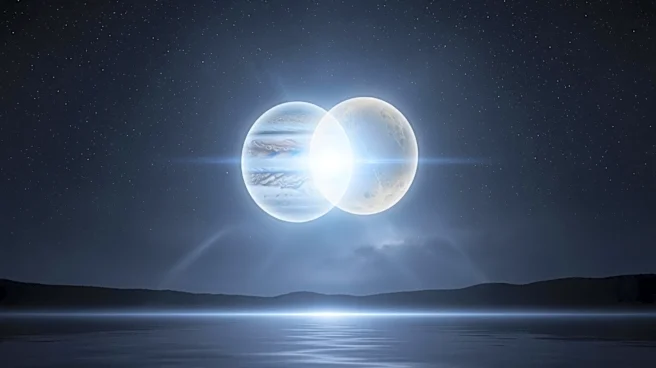
This week, Jupiter and Venus are set to create a striking conjunction in the night sky, a celestial event that will be visible to observers with clear skies. The conjunction is part of a series of astronomical
events occurring from June 5 to June 12, 2026. During this period, the Moon will also pass close to several planets, including Neptune and Saturn, providing additional opportunities for skywatchers to observe these celestial bodies. The Summer Triangle asterism, featuring the stars Deneb, Vega, and Altair, will be prominently visible, offering a chance to explore the constellations associated with these stars. Additionally, the globular cluster M5 and the Sunflower Galaxy (M63) are highlighted as targets for amateur astronomers using telescopes or binoculars.
Why It's Important?
The conjunction of Jupiter and Venus is a significant event for both amateur and professional astronomers, as it provides a rare opportunity to observe two of the brightest planets in close proximity. Such events can spark public interest in astronomy and encourage educational activities related to space and science. The visibility of other celestial objects, like the Summer Triangle and various star clusters, enhances the experience for skywatchers, promoting a greater appreciation for the night sky. These events also serve as a reminder of the dynamic nature of our solar system and the ongoing movements of celestial bodies, which can have implications for scientific research and understanding of planetary interactions.
What's Next?
As the conjunction of Jupiter and Venus unfolds, astronomers and enthusiasts will likely continue to monitor the event, capturing images and data for analysis. The visibility of the Moon near other planets, such as Neptune and Saturn, will provide additional observational opportunities. These events may lead to increased public engagement with astronomy, potentially inspiring future educational programs or public viewing events. The ongoing observation of celestial phenomena contributes to the broader scientific understanding of planetary movements and interactions, which can inform future research and exploration missions.