






What's Happening?
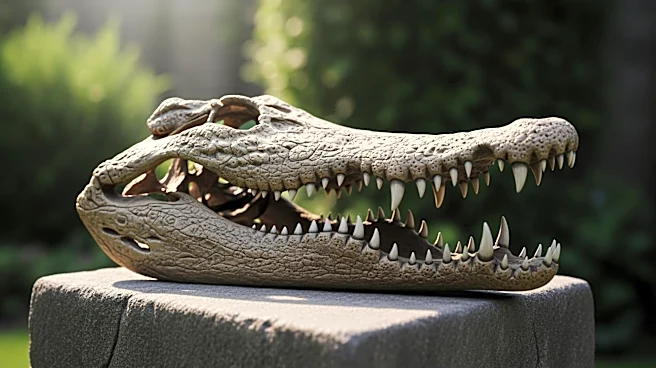
The Tellus Science Museum in Cartersville, Georgia, has unveiled a life-size replica of Deinosuchus schwimmeri, a prehistoric crocodilian that lived in the eastern United States between 83 million and 76 million years ago. This massive predator, known
for preying on dinosaurs, could grow up to 31 feet long. The replica was created through a collaboration between Dr. David Schwimmer, a geology professor at Columbus State University, and Triebold Paleontology Inc. The project took two years to complete and is the first scientifically accurate, fully mounted skeleton of the species. The museum aims to educate visitors about the region's ancient ecosystem during the Cretaceous Period.
Why It's Important?
The display of Deinosuchus schwimmeri at the Tellus Science Museum provides a unique educational opportunity for students and visitors to learn about the prehistoric ecosystem of the southeastern United States. By showcasing this ancient predator, the museum enhances public understanding of the region's natural history and the evolutionary dynamics of the Cretaceous Period. The project also highlights the importance of paleontological research and collaboration in reconstructing the past, offering insights into the survival strategies of apex predators and their role in ancient ecosystems.
What's Next?
The Tellus Science Museum plans to continue its educational outreach by incorporating the Deinosuchus schwimmeri replica into school field trips and public programs. The museum's unique exhibit is expected to attract visitors from across Georgia and neighboring states, providing a platform for further discussions on paleontology and the history of life on Earth. Dr. Schwimmer's ongoing research and potential updates to his work on Deinosuchus may lead to new discoveries and exhibits in the future.