


What's Happening?
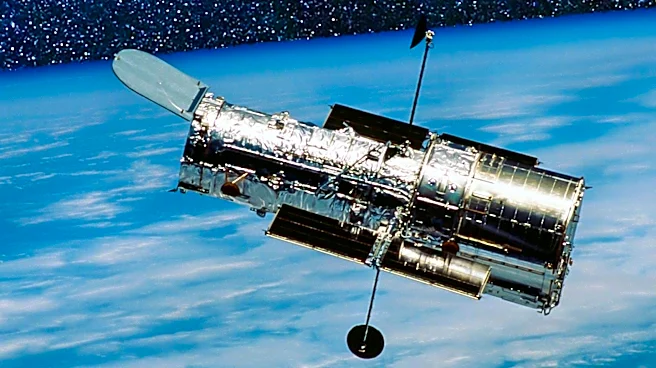
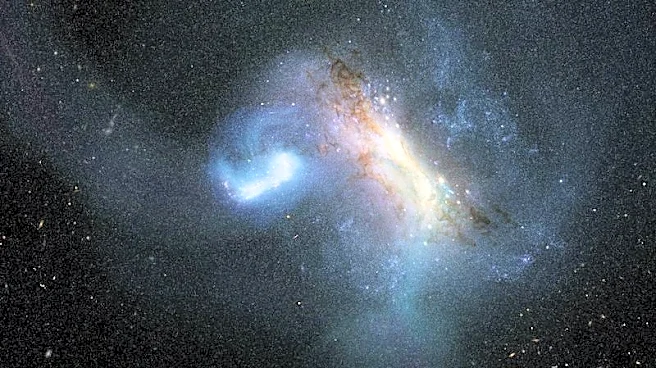
New data from the NASA/ESA Hubble Space Telescope, combined with measurements from ESA's Gaia mission, has provided definitive evidence of an ancient collision between the young Milky Way galaxy and a dwarf galaxy named LKH (Low-energy–Kraken–Heracles)
approximately 11.8 billion years ago. This event, occurring just 2 billion years after the Big Bang, predates previously identified major mergers in the Milky Way's history, such as the collision with the Gaia–Sausage–Enceladus (GSE) galaxy 10 billion years ago. Researchers identified a third population of globular clusters within the Milky Way that are neither native to our galaxy nor from the GSE merger. By precisely measuring the age and metal content of these clusters, scientists determined they originated from LKH, a dwarf galaxy with a total mass of about 500 million times the mass of our sun, which was a significant fraction of the Milky Way's mass at that early stage.
Why It's Important?
This discovery significantly extends our understanding of the Milky Way's formation and evolution, pushing back the timeline of its major growth events by 1.8 billion years. For U.S. astronomy and space science, this research, supported by NASA's involvement with the Hubble Space Telescope, provides crucial insights into how galaxies grow and evolve in the early universe. The finding challenges previous assumptions that the earliest phases of our galaxy's evolution were solely defined by stars born within the Milky Way, emphasizing the role of external galaxies and mergers in shaping its structure and chemical composition. Understanding these ancient collisions is vital for developing more accurate models of galaxy formation and for interpreting observations of distant galaxies. This detective work in cosmic archaeology helps to piece together the complex history of our galactic home, contributing to the broader scientific endeavor of understanding the universe.
What's Next?
The research team plans to continue studying the Milky Way's globular clusters to unravel more of its cosmic history. By analyzing additional clusters, they aim to characterize all the massive mergers our galaxy has experienced throughout its existence. Future observations with advanced telescopes will likely provide even more detailed data, allowing astronomers to refine their models of galactic evolution. This ongoing work will contribute to a more complete picture of how galaxies, including our own, assembled their mass and structure over billions of years. The insights gained from studying the Milky Way's past will also inform our understanding of galaxy formation processes observed in the distant universe, where galaxies are still actively merging and evolving.
Beyond the Headlines
The discovery of the LKH merger has profound implications for our understanding of cosmic evolution and the fundamental processes that govern the universe. It highlights the dynamic and often violent nature of galactic formation, where collisions and mergers are not just incidental events but crucial drivers of growth and change. This research also underscores the power of combining data from multiple advanced observatories, like Hubble and Gaia, to piece together complex cosmic narratives. Philosophically, it reinforces the idea that our galactic home is a product of a long and intricate history of interactions, constantly evolving through the absorption of smaller systems. This continuous process of cosmic cannibalism shapes the chemical enrichment of galaxies, influencing the conditions for star and planet formation, and ultimately, the potential for life. The study of these ancient events connects us to the earliest moments of the universe, offering a glimpse into the grand tapestry of cosmic history.