






What's Happening?
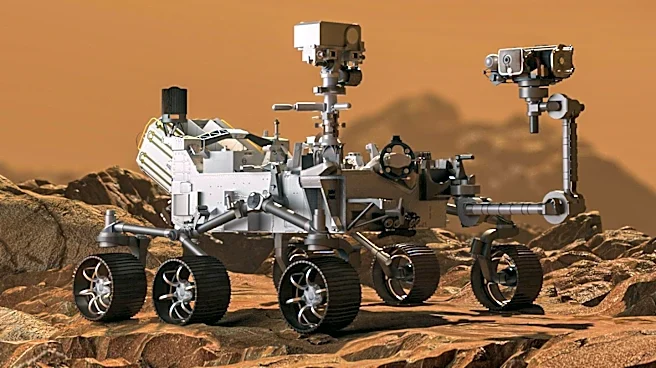
NASA's Curiosity rover has captured a striking image of dawn on the Martian surface, showcasing sunlight illuminating jagged, wind-carved crags. The image was taken by the rover's Mastcam camera approximately an hour after sunrise, revealing a landscape
of yardangs on Mount Sharp. These crags are believed to have formed from wind-blown sediment, possibly sand or volcanic ash, that hardened into rock about 3 billion years ago. Planetary scientist Ashwin Vasavada of NASA's Jet Propulsion Laboratory noted the unique appearance of this rock layer compared to others the rover has traversed. The Curiosity rover, which landed in 2012 in Gale Crater, has been steadily climbing Mount Sharp since 2014, gaining over 0.6 miles in elevation. Its mission involves studying Mars' geology and climate to determine if the planet once harbored conditions suitable for microbial life. The rover is expected to reach the yardang layer in 2027 or 2028 to conduct further geological analysis.
Why It's Important?
This new image from the Curiosity rover is important for several reasons. Firstly, it provides valuable visual data that helps scientists understand the geological history and processes shaping the Martian surface. The distinct yardang layer offers clues about past wind patterns and potential volcanic activity, contributing to a more complete picture of Mars' evolution. Secondly, the ongoing exploration by Curiosity is crucial for the broader scientific goal of assessing Mars' past habitability. By studying different geological layers, scientists can infer the presence of ancient water bodies, which are essential for life. The rover's continuous ascent of Mount Sharp allows for a layered examination of Martian history, akin to reading a geological textbook. This mission, alongside the Perseverance rover, represents a significant investment in understanding our planetary neighbors and the potential for life beyond Earth, informing future human exploration endeavors.
What's Next?
NASA's Curiosity rover is projected to reach the distinctive yardang layer on Mount Sharp in 2027 or 2028. Upon arrival, the rover will utilize its scientific instruments to meticulously scrutinize the geology of this ancient rock formation. This detailed examination is expected to provide further insights into the origins of the wind-carved crags, potentially confirming theories about their formation from wind-blown sediment or volcanic ash. The data collected will contribute to a deeper understanding of Mars' geological and climatic history, particularly regarding periods when the planet was warmer and wetter. The findings will also inform ongoing research into the potential for past microbial life on Mars, guiding future missions and scientific inquiries into the planet's habitability.
Beyond the Headlines
The image of the Martian dawn, while visually striking, also carries deeper implications for our understanding of planetary science and the search for extraterrestrial life. The comparison drawn by planetary scientist Ashwin Vasavada to Earth's Monument Valley, despite the orange sky and blue-tinged sunrise, highlights the blend of familiarity and alienness that characterizes Mars. This duality underscores the scientific endeavor to find commonalities and differences between Earth and other celestial bodies, which can refine our models of planetary formation and evolution. Furthermore, the continuous effort to understand Mars' past conditions, particularly the presence of water, is not just about geology; it's about placing Earth's unique life-supporting environment into a broader cosmic context. The long-term goal is to determine if life is a common phenomenon or a rare occurrence, with Mars serving as a crucial case study in this profound scientific quest.