
What's Happening?
Space debris, also known as orbital debris, refers to human-made objects in space that are no longer functional. This includes inactive satellites, spent rocket stages, and fragments from collisions. Recently,
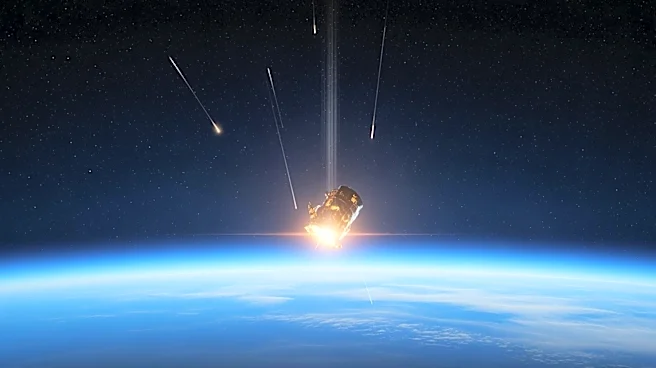
a glowing object, identified as space debris, was observed streaking across the sky in Lampung, Indonesia. This phenomenon occurs when debris in low Earth orbit (LEO) experiences air resistance, causing it to slow down and eventually descend towards Earth. During re-entry, the debris travels at high speeds, generating intense heat due to friction with air particles, which causes most of it to burn up and disintegrate. However, larger objects or those made of heat-resistant materials may partially survive and fall to Earth. The increase in space debris is attributed to the rising number of satellite launches, particularly internet satellite constellations like SpaceX's Starlink, and anti-satellite weapon tests that create numerous fragments.
Why It's Important?
The growing amount of space debris poses significant risks to both space operations and Earth. In space, debris can collide with operational satellites, potentially causing damage or destruction, which could disrupt communication, navigation, and other satellite-dependent services. On Earth, while most debris burns up upon re-entry, the potential for larger pieces to reach the surface poses a safety risk. The increasing density of debris in orbit also raises concerns about the long-term sustainability of space activities. As more countries and companies launch satellites, the risk of collisions and the creation of additional debris fragments increase, potentially leading to a cascade effect known as the Kessler Syndrome, where space becomes increasingly hazardous for new launches.
What's Next?
Efforts to mitigate space debris are underway, with international space agencies and private companies exploring solutions such as debris removal technologies and improved satellite design to minimize debris creation. Policies and regulations are being developed to manage space traffic and ensure responsible behavior in space. The international community is also working on agreements to prevent anti-satellite weapon tests that contribute to debris. As space activities continue to grow, collaboration among nations and organizations will be crucial to address the challenges posed by space debris and ensure the safe and sustainable use of space.
Beyond the Headlines
The issue of space debris highlights broader ethical and legal challenges in space governance. Questions about liability for damage caused by debris, the responsibility for debris removal, and the equitable use of space resources are becoming increasingly important. The situation also underscores the need for international cooperation in space exploration and the development of comprehensive frameworks to manage space activities. As space becomes more accessible, ensuring that it remains a shared and sustainable environment is a critical challenge for the global community.