
What's Happening?
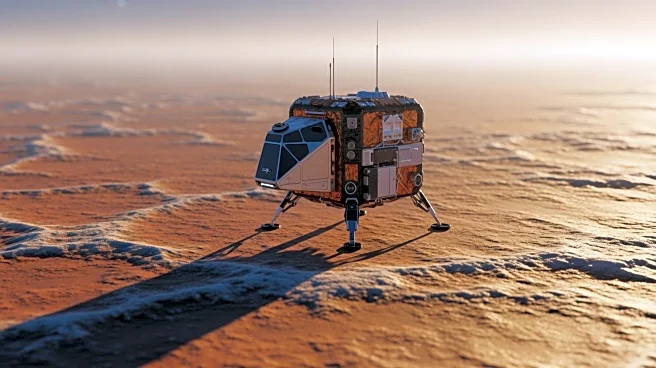
On January 14, 2005, the Huygens probe successfully landed on the surface of Titan, Saturn's largest moon, marking a significant milestone in space exploration. The probe, part of the Cassini-Huygens mission,
was the first to land on Titan, providing unprecedented data and images of its surface. Huygens' descent through Titan's thick atmosphere was a complex process, involving a heat shield and parachutes to ensure a safe landing. The probe transmitted data for 72 minutes after landing, capturing images of a landscape resembling a damp, sandy beach with scattered rocks.
Why It's Important?
The Huygens mission provided the first direct observations of Titan's surface, offering valuable insights into its composition and atmospheric conditions. Titan is of particular interest to scientists due to its thick atmosphere and the presence of liquid methane and ethane lakes, which could offer clues about prebiotic chemistry. The data collected by Huygens has been instrumental in advancing our understanding of Titan and has informed subsequent missions and studies focused on this intriguing moon.
Beyond the Headlines
The success of the Huygens mission demonstrated the feasibility of landing on and exploring distant celestial bodies with thick atmospheres. It paved the way for future missions to Titan and other similar moons, highlighting the potential for discovering new forms of life or prebiotic conditions. The mission also underscored the importance of international collaboration in space exploration, as it was a joint effort between NASA, the European Space Agency, and the Italian Space Agency.