
What's Happening?
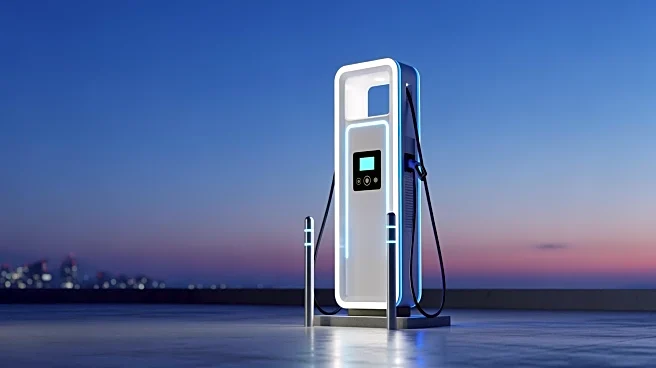
IONNA, a joint venture founded by eight global automakers, has launched new electric vehicle (EV) charging stations in Illinois, marking a significant expansion of the state's EV infrastructure. The rollout
includes five locations, with Wally’s in Pontiac and two Casey’s stores in McHenry and Vernon Hills among the first to feature these 'rechargeries.' Each site offers multiple charging bays, with power supplied by ComEd and Ameren. This initiative is part of a broader effort to enhance the Midwest travel corridor and support the growing number of EVs in the region. Illinois Governor JB Pritzker highlighted the state's commitment to EV infrastructure at the ribbon-cutting ceremony, noting the allocation of $148 million in federal funds for the National Electric Vehicle Infrastructure (NEVI) program. This funding has already facilitated the construction of 349 new charging ports across the state.
Why It's Important?
The expansion of EV charging infrastructure in Illinois is crucial for supporting the increasing adoption of electric vehicles. With over 162,000 battery electric vehicles now on Illinois roads, the demand for accessible and reliable charging options is growing. The state's investment in EV infrastructure not only supports environmental goals but also stimulates economic growth by creating jobs and attracting private investment. The presence of charging stations at popular convenience stores like Wally’s and Casey’s enhances the convenience and appeal of EV ownership, potentially accelerating the transition to electric vehicles. Additionally, the state's EV rebate program, which offers financial incentives to purchasers, further encourages the adoption of cleaner transportation options.
What's Next?
As Illinois continues to develop its EV ecosystem, more charging sites are expected to be contracted or go live in the near future. The state plans to build on its current infrastructure, with additional locations in Springfield, Chicago, and other cities. This expansion is likely to attract further private investment, as evidenced by the significant number of charging stations established without federal or state grants. The ongoing development of EV infrastructure will play a key role in making electric vehicles a more viable and attractive option for consumers, contributing to the state's environmental and economic objectives.