





What's Happening?
Researchers at UC Berkeley, in collaboration with NVIDIA, have unveiled open-source code for AI agents designed to construct and refine robot control programs. This innovative approach, termed 'agentic robotics,' aims to alleviate the burdens of manual
robot programming and the extensive data sets typically required for machine learning. The core of their method is the Graph-as-Policy (GaP) framework, which represents tasks as interconnected steps for perception, planning, and control, drawing from a modular library of existing robot skills. AI agents generate these connections and then utilize NVIDIA's Isaac simulation libraries to rehearse variations, identify failures, and modify programs before deployment to physical robots. This research, presented at the Conference on Robot Learning, includes an industrial-task benchmark to facilitate broader adoption by roboticists.
Why It's Important?
This development holds significant importance for the future of industrial automation and robotics. By reducing the need for extensive hand-programming and large datasets, 'agentic robotics' could dramatically lower the cost and complexity of deploying robots in diverse industrial settings, particularly those with variable object shapes and positions. This could accelerate the adoption of automation in sectors where it was previously impractical or too expensive. The ability for AI agents to learn from failures in simulation and refine their programs autonomously represents a leap forward in robot intelligence and adaptability. This could lead to more robust and versatile robotic systems, capable of handling unforeseen challenges and improving their performance over time. The open-source nature of the code also fosters collaboration and innovation within the robotics community, potentially leading to rapid advancements and new applications.
What's Next?
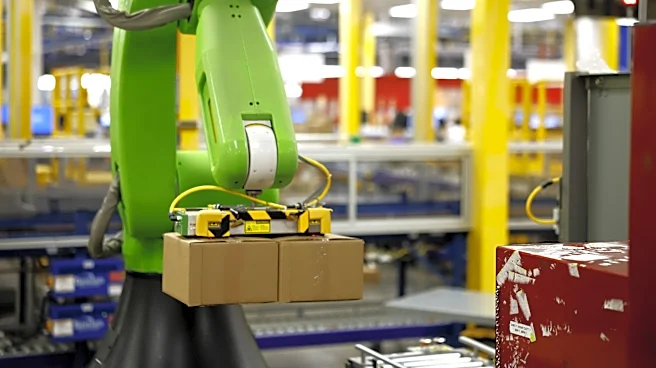
The release of the open-source code and the industrial-task benchmark is expected to encourage other roboticists to experiment with and build upon the 'agentic robotics' approach. This could lead to a faster pace of development and wider application of these techniques across various industries. Future work will likely focus on enhancing the AI agents' ability to infer real-world assumptions more accurately, as highlighted by the example of the robot failing to reliably infer a bar's mass. Integrating video feedback from real-world failures back into simulations for program revision will be a key area of improvement. The success of companies like Ambi Robotics in using GaP-based systems for package handling suggests a practical and immediate impact on logistics and manufacturing. Continued research will aim to expand the general-purpose competence of these AI-driven robots beyond specific evaluated tasks.
Beyond the Headlines
The concept of AI agents autonomously building and improving robot programs raises profound questions about the future of work and the nature of human-robot collaboration. As robots become more self-sufficient in their programming and learning, the role of human engineers may shift from direct programming to oversight, refinement, and setting high-level objectives. This could lead to increased productivity and efficiency, but also necessitates a re-evaluation of skill sets required in the workforce. Furthermore, the ability of AI to learn from simulated failures and adapt raises ethical considerations regarding accountability and control in increasingly autonomous systems. The potential for robots to develop and refine their own behaviors without constant human intervention could lead to unforeseen outcomes, emphasizing the need for robust safety protocols and transparent AI development practices. This technology could fundamentally alter the landscape of industrial production and the human-machine interface.