


What's Happening?
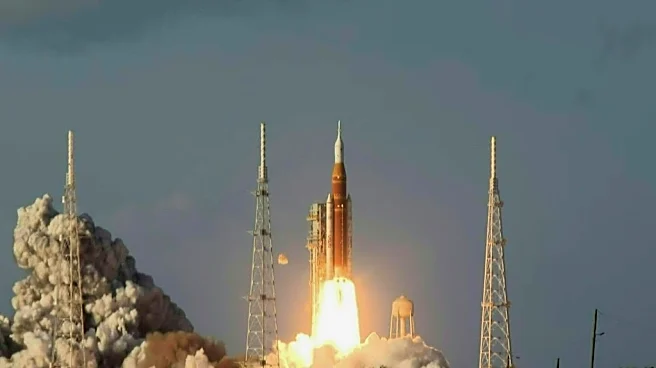
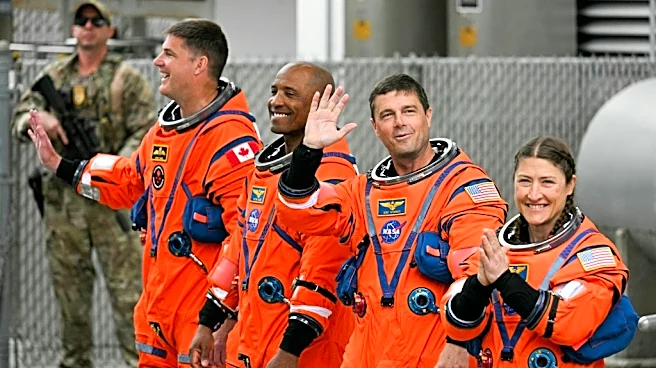
NASA has successfully launched the Artemis II mission, marking the first crewed flight to the moon since the Apollo program ended in 1972. The mission, which took off from Cape Canaveral, Florida, involves four astronauts: Reid Wiseman, Victor Glover,
Christina Koch, and Canadian astronaut Jeremy Hansen. This mission is the second flight for NASA's Space Launch System rocket and the Orion crew capsule, but it is the first to carry a crew. The astronauts will spend the initial two days orbiting Earth, conducting tests on the spacecraft, including a manual docking procedure. The mission will then proceed to a loop around the moon, reaching a distance of approximately 402,000 kilometers from Earth, surpassing the record set by Apollo 13. The mission is expected to last about 10 days before the Orion capsule returns to Earth.
Why It's Important?
The Artemis II mission is a significant milestone in NASA's efforts to return humans to the moon and establish a sustainable presence there. This mission serves as a critical test of the Space Launch System and Orion crew capsule, paving the way for future missions, including Artemis III and IV, which aim to land astronauts on the lunar surface and eventually establish a permanent moon base. The success of Artemis II could reignite interest in lunar exploration and inspire international collaboration in space exploration. It also represents a step towards broader goals of human exploration beyond the moon, potentially to Mars and other destinations in the solar system.
What's Next?
Following the successful completion of Artemis II, NASA plans to proceed with Artemis III, initially intended as a lunar landing mission but now set to remain in orbit to test docking systems with lunar landers. Artemis IV, scheduled for 2028, is expected to achieve the lunar landing. These missions are part of NASA's broader Artemis program, which aims to establish a long-term human presence on the moon. The outcomes of these missions will inform future strategies for deep space exploration and the development of technologies necessary for sustained human habitation on the moon.