






What's Happening?
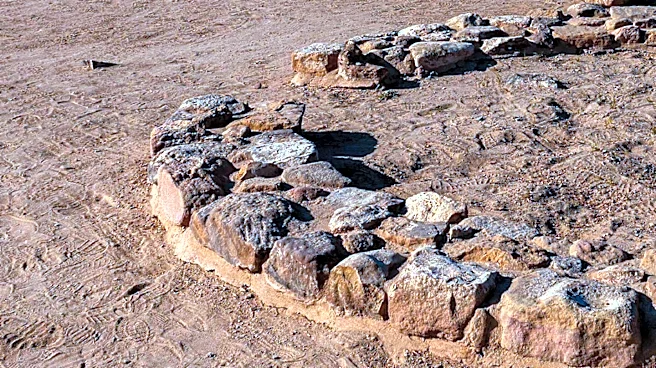
Archaeologists in El Salvador have uncovered a 2,800-year-old burial site featuring a human skeleton interred with a ceramic vessel shaped like a sea turtle. The burial, found in Antiguo Cuscatlán, may belong to a pre-Maya civilization known for practicing
human sacrifice. The skeleton was discovered beneath volcanic ash from an eruption dated between 850 and 830 B.C. This period in Mesoamerica was marked by the development of more complex societies. The burial's unusual position and accompanying artifacts suggest possible links to ancient cosmological beliefs, with the sea turtle vessel potentially symbolizing elements of the cosmos.
Why It's Important?
This discovery provides valuable insights into the cultural and religious practices of pre-Maya civilizations in Mesoamerica. The presence of the sea turtle vessel and the burial's context may offer clues about ancient beliefs regarding the cosmos and the afterlife. Such findings contribute to a deeper understanding of the region's historical development and the evolution of its societies. The archaeological evidence of potential human sacrifice practices also sheds light on the social and ritualistic aspects of these early cultures, offering a broader perspective on their way of life and spiritual beliefs.
What's Next?
Further analysis of the skeleton and artifacts is expected to provide more detailed information about the individual's life, diet, and cause of death. Researchers will continue to explore the site for additional burials, which could offer more comprehensive insights into the burial practices and societal structures of the time. The findings will be crucial for understanding the cultural and historical context of the region, potentially leading to new interpretations of Mesoamerican history and its influence on subsequent civilizations.