



What's Happening?
A recent study published in the Journal of Neuroscience has uncovered that astronauts' memories of Earth's gravity influence how they grip objects, even after extended periods in space. The research, led by Philippe Lefèvre, a biomedical engineer at the Catholic
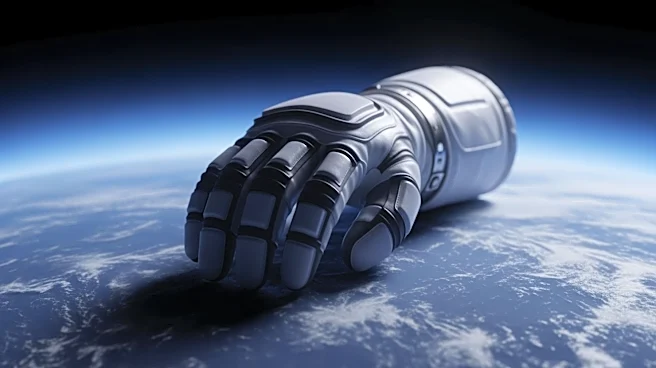
University of Louvain, analyzed the grip dynamics of 11 astronauts aboard the International Space Station (ISS). The findings indicate that astronauts tend to use a stronger grip than necessary, as if compensating for Earth's gravity, despite knowing that objects are weightless in space. This overcompensation could have significant safety implications, as incorrect gripping might lead to objects slipping, posing risks during space missions. The study highlights the need for astronauts to adapt their motor skills to microgravity environments, which could be crucial for future missions to the moon or Mars.
Why It's Important?
Understanding how astronauts' motor skills are affected by microgravity is vital for ensuring safety during space missions. The study's findings suggest that astronauts' ingrained memory of Earth's gravity leads to overcompensation in their grip, which could result in objects slipping and causing potential hazards. As space agencies plan for future missions to the moon and Mars, training astronauts to adapt to different gravitational environments becomes increasingly important. This research could inform the development of training programs that help astronauts adjust their motor skills, reducing the risk of accidents and improving the safety of space operations. The ability to handle objects safely in space is crucial for conducting experiments and maintaining equipment, making this study a significant contribution to space exploration safety protocols.
What's Next?
As space exploration continues to advance, the insights from this study could lead to the development of specialized training programs for astronauts. These programs would focus on helping astronauts adapt their motor skills to various gravitational environments, such as the moon's partial gravity or Mars' different gravitational pull. Additionally, further research could explore how long-term exposure to microgravity affects other aspects of human physiology and cognition. Space agencies may also consider implementing new safety measures and equipment designs to mitigate the risks associated with incorrect gripping in space. As missions to the moon and Mars become more frequent, ensuring astronauts can safely manipulate objects will be a critical component of mission planning and execution.