
What's Happening?
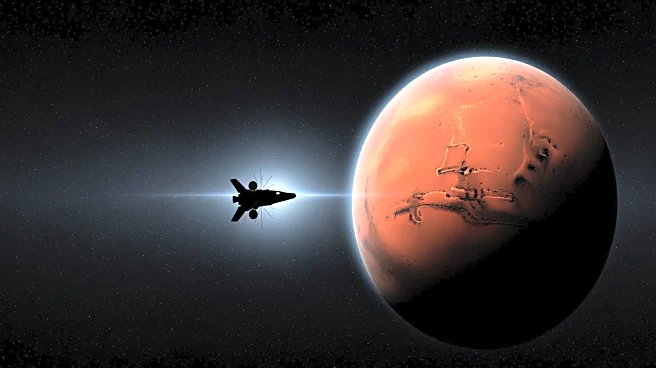
NASA has announced the loss of contact with the Mars Atmosphere and Volatile Evolution (MAVEN) spacecraft, which has been orbiting Mars since September 2014. The spacecraft, launched in November 2013,
was designed to study the interaction between Mars' upper atmosphere and ionosphere with the Sun and solar wind. This mission has been crucial in understanding the loss of the Martian atmosphere into space. Before losing contact on December 6, telemetry indicated that all subsystems were functioning normally. MAVEN has also played a significant role as a communications relay for rovers on Mars' surface and has been linked with other Mars missions such as the Mars Reconnaissance Orbiter and Mars Odyssey.
Why It's Important?
The loss of contact with MAVEN represents a significant setback for NASA's Mars exploration efforts. MAVEN has provided valuable data on Mars' atmospheric conditions, climate, and potential habitability, which are critical for future missions aimed at exploring the possibility of life on Mars. The spacecraft's role as a communications relay is also vital for ongoing and future rover missions. This incident underscores the challenges of maintaining long-term space missions and the need for robust systems to ensure continuous data flow. The loss could delay scientific research and impact the planning of future missions to Mars.
What's Next?
NASA's spacecraft and operations teams are currently investigating the cause of the communication loss and are expected to provide updates as they become available. The outcome of this investigation will determine the next steps in attempting to re-establish contact with MAVEN. Meanwhile, NASA may need to rely more heavily on other Mars missions, such as the Mars Reconnaissance Orbiter and Mars Odyssey, to continue gathering data. The agency will likely assess the implications of this loss on its broader Mars exploration strategy and consider adjustments to ensure the continuity of its scientific objectives.