






What's Happening?
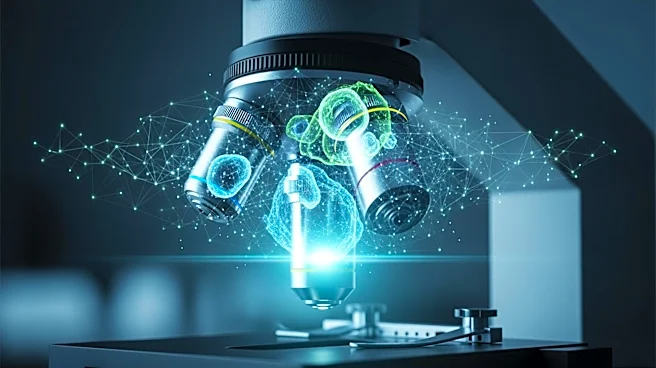
Engineers at the University of California San Diego have developed an AI-enhanced microscopy technique that allows for real-time, high-resolution video imaging of live cells. This advancement, published in Nature Communications, utilizes an algorithm
that significantly speeds up the image processing of structured illumination microscopy (SIM), a method that enhances image detail by using patterned light. The new technique, called unrolled blind-SIM (UBSIM), integrates artificial intelligence to produce high-quality images instantly, avoiding the introduction of false details. This innovation allows scientists to observe cellular processes in real time, with the ability to capture rapid changes in structures like the endoplasmic reticulum at up to 50 frames per second.
Why It's Important?
The development of UBSIM represents a major leap forward in microscopy, making super-resolution imaging more accessible and practical for everyday research. By providing real-time, high-resolution images without the need for extensive processing, this technology enhances the ability of researchers to study live cells and their functions. This could lead to breakthroughs in understanding cellular processes and disease mechanisms, potentially accelerating the development of new treatments. The integration of AI into microscopy also sets a precedent for future innovations in scientific imaging, where speed and accuracy are critical for advancing research.