





What's Happening?
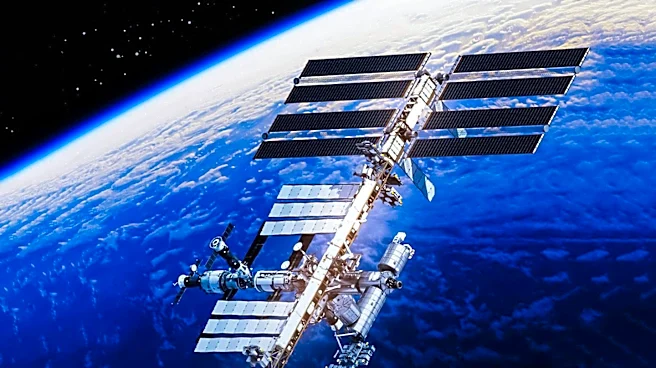
The International Space Station (ISS) National Laboratory and the U.S. National Science Foundation (NSF) have announced the selection of two new research projects. These projects will utilize the unique microgravity environment of the orbiting laboratory
to advance the understanding of fluid transport phenomena. The investigations build upon over a decade of collaboration between the ISS National Lab and NSF, which has supported nearly 100 projects in areas such as biotechnology, fluid dynamics, and combustion. The two newly selected projects will explore fundamental processes relevant to advanced manufacturing, energy systems, and healthcare technologies. Patricia Weisensee from Washington University in St. Louis will lead a project on the melting dynamics of small particles to improve metal 3D printing and applications like drug delivery. Chen Li from the University of South Carolina will investigate slip ratio in microgravity two-phase flows to design more efficient heat-transfer and cooling systems for both space and Earth applications.
Why It's Important?
These NSF-funded projects are crucial for advancing scientific knowledge and developing technologies with significant real-world applications. Research conducted in microgravity allows scientists to isolate and study phenomena without the confounding effects of gravity, leading to more accurate models and deeper insights. For instance, understanding particle melting in microgravity can revolutionize metal 3D printing, enabling the creation of stronger, more uniform materials for various industries. Similarly, optimizing heat-transfer systems through microgravity research can lead to more efficient electronics cooling, refrigeration, and spacecraft thermal control, impacting everything from consumer electronics to advanced aerospace systems. The collaboration between the ISS National Lab and NSF underscores the U.S.'s commitment to leveraging space-based research for terrestrial benefits, fostering innovation, and maintaining leadership in science and engineering.
What's Next?
The two selected projects will commence their research on the International Space Station, leveraging its microgravity environment. Researchers will conduct experiments to gather data on particle melting dynamics and two-phase flow behavior. The insights gained from these experiments are expected to lead to the development of more accurate models and improved designs for advanced manufacturing techniques, drug delivery systems, and heat-transfer technologies. The ISS National Lab and NSF will continue their partnership, likely announcing future calls for proposals to utilize the ISS for fundamental science research. The findings from these projects will be disseminated through peer-reviewed publications, contributing to the broader scientific community and potentially leading to new patents and commercial applications. This ongoing research will continue to demonstrate how space-based science can yield tangible benefits for life on Earth.
Beyond the Headlines
The research conducted on the ISS, particularly in microgravity, offers a unique window into fundamental physics and material science that is impossible to replicate on Earth. The ability to isolate non-gravitational forces allows for a purer understanding of phenomena like fluid dynamics and material interactions. This not only pushes the boundaries of scientific knowledge but also has the potential to unlock entirely new technological capabilities. For example, improved metal 3D printing could lead to lighter, stronger components for aerospace, automotive, and medical industries. More efficient cooling systems could address the growing energy demands of data centers and high-performance computing. Furthermore, the long-standing partnership between the ISS National Lab and NSF exemplifies a successful model of public-private collaboration in scientific research, demonstrating how shared resources and expertise can accelerate innovation and deliver societal impact. This continuous investment in fundamental research in space reinforces the strategic value of the ISS beyond its role as an outpost for human exploration.