




What's Happening?
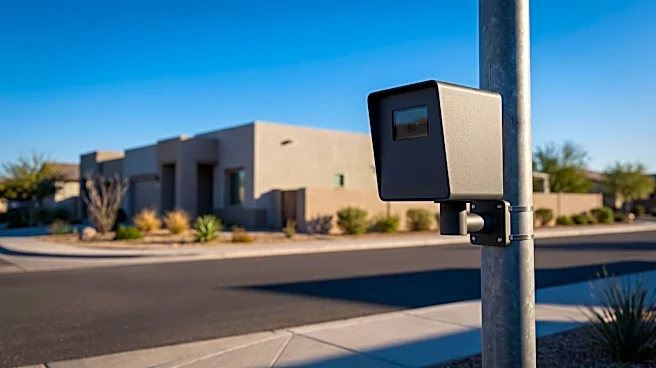
Nevada Governor Joe Lombardo has publicly stated his support for the responsible use of advanced technology, specifically automated license plate readers (ALPRs) or 'Flock' cameras, as tools to combat crime and enhance public safety in Nevada. This stance
comes as a debate intensifies within the state regarding the deployment and regulation of these surveillance technologies. Assemblymember Selena La Rue Hatch is proposing a bill for an outright ban on ALPRs, citing concerns from her constituents and the ACLU of Nevada about a potential 'surveillance state.' In contrast, law enforcement and security experts, such as Michael Johnston of Code 4 Consulting, advocate for ALPRs as crucial investigative tools that provide leads to solve crimes and locate missing persons, emphasizing that these systems monitor public rights-of-way, not private spaces. Attorney General Aaron Ford, who is running for governor, has called for immediate guardrails to protect Nevadans' privacy, stating he does not support the use of Flock cameras until such protections are legally established. The Las Vegas Metropolitan Police Department (LVMPD) currently discloses its number of Flock cameras, usage policies, and search protocols online.
Why It's Important?
The debate over automated license plate readers in Nevada highlights a critical tension between public safety and individual privacy rights, a discussion with significant implications for U.S. society and policy. Governor Lombardo's support for 'responsible use' underscores the perceived benefits of these technologies in law enforcement, potentially leading to more efficient crime solving and increased public safety. However, the push for an outright ban by Assemblymember La Rue Hatch and the call for immediate guardrails by Attorney General Ford reflect growing concerns about government surveillance and the potential for misuse of data collected from ALPRs. The outcome of this debate in Nevada could set a precedent for other states grappling with similar issues, influencing future legislation on surveillance technology nationwide. The balance struck between these competing interests will determine the extent to which advanced technology is integrated into policing while safeguarding constitutional rights, affecting how citizens perceive their privacy in public spaces and their trust in law enforcement.
What's Next?
The immediate next step in Nevada will likely involve legislative action, with Assemblymember Selena La Rue Hatch proposing a bill for an outright ban on automated license plate readers. This proposal will initiate a formal debate within the state legislature, where lawmakers will consider the arguments for and against the technology, as well as potential compromises such as the implementation of strict guardrails. Attorney General Aaron Ford's call for immediate legal protections suggests that even if a full ban is not enacted, there will be significant pressure to establish comprehensive regulations governing the use, data retention, and access protocols for ALPRs. The ongoing gubernatorial race will also keep this issue in the public eye, as both Governor Lombardo and Attorney General Ford have articulated their positions, making it a potential campaign topic. Stakeholders, including law enforcement agencies, privacy advocates, and technology providers, will likely engage in lobbying efforts to influence the legislative outcome, shaping the future of surveillance technology in Nevada.
Beyond the Headlines
The controversy surrounding automated license plate readers in Nevada extends beyond immediate legislative and political debates, touching upon deeper ethical and societal implications. The widespread deployment of ALPRs raises fundamental questions about the nature of privacy in an increasingly surveilled public sphere. While proponents argue that these cameras only record vehicles in public rights-of-way, the aggregation of this data can create detailed movement patterns of individuals, potentially leading to concerns about profiling, data security, and the scope of government oversight. The discussion also highlights the evolving challenge of adapting constitutional rights, particularly the Fourth Amendment's protection against unreasonable searches, to new technological capabilities. The outcome in Nevada could influence the national conversation on how to balance technological advancements for security with the preservation of civil liberties, potentially leading to broader legal interpretations or federal guidelines regarding data collection and surveillance in public spaces. This debate is a microcosm of the larger societal challenge of integrating powerful technologies responsibly.