



What's Happening?
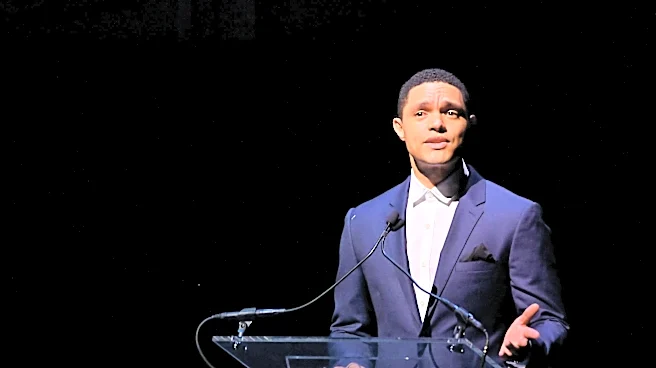
Comedian and former 'The Daily Show' host Trevor Noah has issued a warning regarding the potential impact of artificial intelligence on the job market. Speaking at Boston's Museum of Science, Noah expressed concerns that AI could eliminate existing jobs
at a faster rate than new employment opportunities become available. This could leave a significant number of displaced workers without immediate employment. His remarks, which were published by AI researcher Oren Etzioni on November 8, also delved into the limitations of AI, the unique aspects of human creativity, and the importance of maintaining personal connections in an increasingly digital world. Noah drew parallels between the current AI boom and past technological shifts that transformed American industries, recalling visits to communities affected by the decline of major employers like Kodak and Studebaker. He noted that while technological progress will undoubtedly create new jobs, the critical question remains about the duration of the transitional period for those who lose their current roles.
Why It's Important?
Trevor Noah's warning highlights a critical concern for the U.S. economy and workforce: the potential for a significant gap between job displacement due to AI and the creation of new roles. This transition period could lead to widespread unemployment and economic instability if not adequately addressed. His comparison to past industrial shifts, such as the decline of Kodak and Studebaker, underscores the profound impact automation can have on local economies and individual livelihoods. The discussion also brings to light the differing perceptions and attention given to job losses among blue-collar versus white-collar workers, suggesting that the current wave of AI-driven displacement among office employees is receiving more attention due to their greater influence. This perspective is crucial for policymakers and businesses as they consider strategies to mitigate the negative consequences of technological advancement and ensure a smoother transition for the workforce.
What's Next?
The concerns raised by Trevor Noah suggest a need for proactive measures from various stakeholders. Policymakers may need to consider new educational and retraining programs to equip displaced workers with the skills required for emerging AI-driven jobs. Businesses might be compelled to invest in reskilling their current workforce to adapt to new technologies rather than solely focusing on automation for cost reduction. Discussions around universal basic income or other social safety nets could also gain traction as a means to support individuals during prolonged periods of unemployment. Furthermore, the dialogue around AI's limitations in understanding human behavior and creativity, as highlighted by Noah, could spur further research and development into more nuanced and ethically sound AI systems. The ongoing conversation will likely involve a broader range of voices, including technologists, economists, and social scientists, to collectively navigate the complex future of work in an AI-dominated landscape.
Beyond the Headlines
Beyond the immediate economic implications, Trevor Noah's commentary touches upon deeper societal and ethical considerations. His questioning of AI's ability to genuinely understand human behavior and humor raises fundamental questions about the nature of intelligence and consciousness. If AI systems can convincingly mimic human interaction without true comprehension, it could lead to a devaluation of authentic human connection and creativity. The emphasis on maintaining strong communities and face-to-face interactions in an AI-pervasive world underscores a growing concern about social isolation and the erosion of genuine human experiences. This development could trigger long-term shifts in how society values work, creativity, and interpersonal relationships, prompting a re-evaluation of what it means to be human in an increasingly automated world. The ethical imperative to ensure that technological progress serves humanity, rather than simply replacing it, becomes a central theme.