










What's Happening?
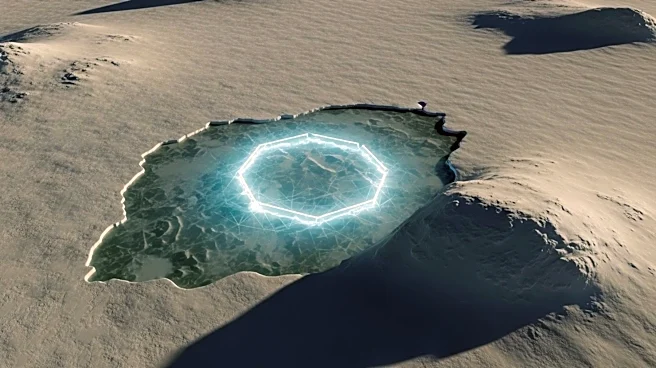
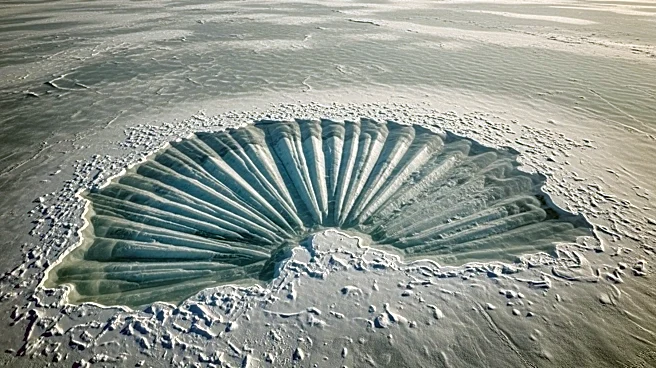
Researchers have identified a massive fan-shaped structure beneath the East Antarctic Ice Sheet, which may have formed during the breakup of the ancient supercontinent Gondwana. This structure, known as the East Antarctic Fan-Shaped Basin Province, is a result
of a tectonic process called distributed rotational extension. This process involves the Earth's crust deforming outward from a central point, creating triangular basins. The discovery, published in Nature Geoscience, suggests that East Antarctica's well-known features, such as the Wilkes and Aurora basins, were formed by this process. The study highlights the dynamic tectonic history of East Antarctica, challenging the perception of the region as a stable cratonic area.
Why It's Important?
The discovery of the East Antarctic Fan-Shaped Basin Province provides new insights into the tectonic history of Antarctica, which could have implications for understanding how the East Antarctic Ice Sheet will respond to climate change. Tectonic processes influence the movement of glaciers and ice streams, affecting their melting paths. This research underscores the complexity of Antarctica's geological history and the potential for further discoveries beneath the ice. Understanding these processes is crucial for predicting future changes in the ice sheet and their global impact.
What's Next?
Further research is needed to test the hypothesis of the fan-shaped structure's formation and to better constrain the timing of the tectonic processes involved. Scientists aim to integrate subglacial topography, gravity, magnetics, crustal structure, and ice-sheet observations to gain a more comprehensive understanding of Antarctica's geological secrets. This ongoing research could lead to new discoveries about the continent's tectonic evolution and its role in global climate dynamics.