



What's Happening?
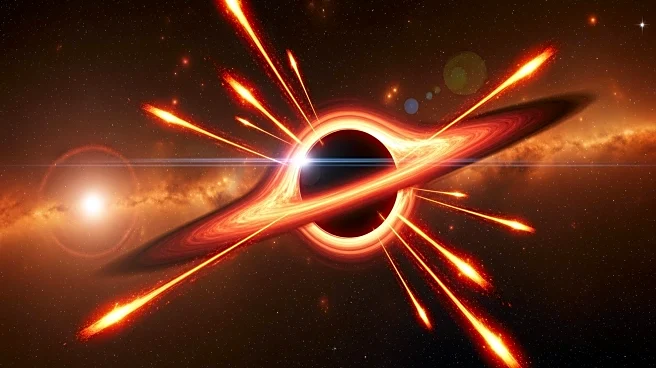
Astronomers have observed a supermassive black hole, located at the center of the galaxy J1007+3540, erupting after a dormancy of approximately 100 million years. This event, described as a 'cosmic volcano', has resulted in an eruption stretching across
1 million light-years. The discovery was made using the Low Frequency Array (LOFAR) in the Netherlands and India's upgraded Giant Metrewave Radio Telescope (uGMRT). The black hole's jets are in a dynamic interaction with the galaxy's gravitational forces, creating a spectacular display of cosmic activity.
Why It's Important?
This observation provides significant insights into the behavior of supermassive black holes and their impact on galaxy formation and evolution. The ability of such black holes to turn on and off over cosmic timescales challenges existing theories about their lifecycle and energy output. Understanding these processes is crucial for astronomers as they seek to comprehend the role of black holes in shaping the universe. The findings could also influence future research on galaxy clusters and the environmental factors affecting black hole activity.
Beyond the Headlines
The eruption of J1007+3540 highlights the complex interactions between black holes and their surrounding environments. The presence of older, exhausted plasma lobes suggests a history of episodic activity, providing a unique opportunity to study the long-term effects of black hole jets on their host galaxies. This research could lead to a deeper understanding of how galaxies grow and evolve over billions of years, offering clues about the early universe and the formation of cosmic structures.