



What's Happening?
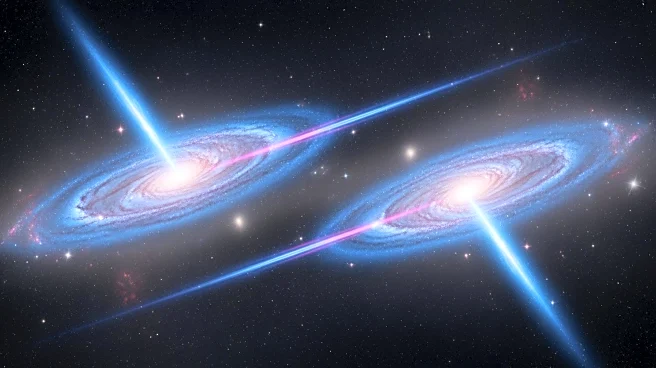
An international team of astronomers, using the Australian Square Kilometer Array Pathfinder (ASKAP), has discovered a significant bipolar outflow from the disk of the nearby galaxy ESO 130-G012. This galaxy, located approximately 55 million light-years
away, features a star-forming disk and a black hole about 50 million times the mass of the sun. The outflow, resembling a closed hourglass, extends 100,000 to 160,000 light-years into the galaxy's halo. The discovery was made as part of the Evolutionary Map of the Universe (EMU) project, with the outflow being detected in 944 MHz radio continuum images. The outflow is believed to be driven by star formation, stellar winds, and cosmic rays, although contributions from a more active black hole or past central starburst cannot be ruled out.
Why It's Important?
The discovery of the bipolar outflow in ESO 130-G012 provides valuable insights into the processes occurring in galaxy halos and the interactions between star formation and galactic structures. Understanding these outflows is crucial for comprehending how galaxies evolve and how matter is distributed in the universe. The findings could influence future astronomical research, offering a new target for studying the disk-halo interface and the mechanisms behind outflow formation. This research enhances our knowledge of galaxy dynamics and the role of black holes and star formation in shaping galactic environments.
What's Next?
The discovery positions ESO 130-G012 as a promising target for further observations. Future studies may focus on modeling the outflow formation and exploring the disk-halo interface in greater detail. These investigations could involve more advanced radio telescopes and collaborations across international astronomical communities. The ongoing research may lead to a deeper understanding of the physical processes driving such outflows and their implications for galaxy evolution.