


What's Happening?
Archaeologists from the University of Western Australia (UWA), working under the Royal Commission for AlUla (RCU), have discovered extensive 'funerary avenues' in ancient north-west Arabia. These pathways, flanked by thousands of burial monuments, connected
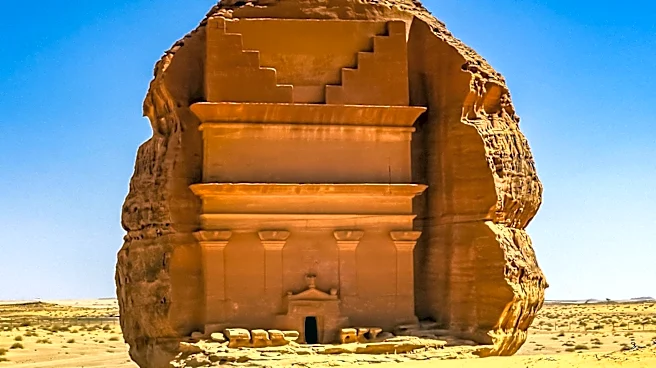
oases and pastures, indicating a sophisticated network of social and economic interaction among populations during the 3rd millennium BCE. The findings, published in The Holocene journal, are part of a broader collaborative effort involving 13 archaeological and conservation project teams globally, working with Saudi experts in AlUla and Khaybar counties in Saudi Arabia. This discovery sheds light on the lives of the region's ancient inhabitants and suggests the existence of complex social structures across a significant portion of the Arabian Peninsula 4,500 years ago. AlUla is also home to Hegra, a UNESCO World Heritage Site known for its carved Nabataean monumental tombs.
Why It's Important?
This discovery is important as it provides new insights into the social and economic organization of ancient societies in the Arabian Peninsula. The existence of long-distance funerary avenues suggests a high degree of connectivity and possibly shared cultural practices among communities over vast distances, challenging previous understandings of their isolation. For the U.S. and international archaeological communities, this research contributes significantly to the global understanding of early human civilization and trade networks. It highlights the potential for further discoveries in the region and underscores the importance of international collaboration in archaeological research. The findings could also influence how historians and anthropologists interpret the development of complex societies and early infrastructure in arid environments, offering parallels or contrasts to similar developments in other parts of the world.
What's Next?
The UWA team's work is part of an ongoing, wider effort that includes 13 archaeological and conservation project teams from around the world collaborating with Saudi experts. Future research will likely involve further analysis of the data collected from these funerary avenues to gain a deeper understanding of the daily lives, social hierarchies, and belief systems of the ancient inhabitants. Dr. Rebecca Foote, Director of Archaeology and Cultural Heritage Research for RCU, anticipates many more publications that will advance knowledge from the Neolithic to the Bronze Age in north-west Arabia, with significant implications for the wider region. This ongoing research is expected to continue attracting international scientific collaboration and further establish Saudi Arabia as a hub for archaeological science.
Beyond the Headlines
The discovery of these funerary avenues extends beyond mere archaeological findings; it offers a profound glimpse into the cultural and spiritual dimensions of ancient Arabian societies. The dedication of resources and effort to construct such extensive burial networks suggests a deep reverence for ancestors and a structured approach to death and remembrance. This could imply a complex belief system and a strong sense of community identity that transcended immediate settlements. Furthermore, the 'funerary avenues' might have served not only as ceremonial routes but also as markers of territorial claims or established trade paths, integrating spiritual and practical aspects of life. The collaborative international effort in AlUla also highlights the ethical and cultural responsibility of preserving and interpreting shared human heritage, fostering cross-cultural understanding through scientific exploration.