






What's Happening?
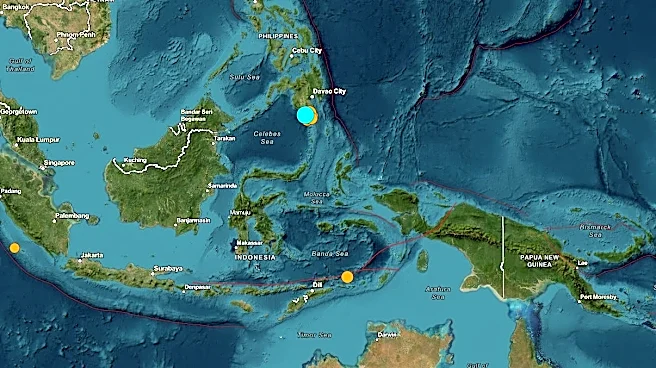
A powerful 7.8 magnitude earthquake struck the southern Philippines early Monday, causing significant damage in the coastal city of General Santos. The earthquake, which occurred at 7:37 a.m., led to power outages and prompted a tsunami warning for several
regional coasts. The epicenter was located 13 kilometers southwest of General Santos at a depth of 10 kilometers. The Pacific Tsunami Warning Center indicated that tsunami waves up to 3 meters could impact some Philippine coasts, while smaller waves were possible in Indonesia and Malaysia. Residents in coastal areas were advised to evacuate to higher ground. The earthquake also caused a partial collapse of a small commercial building in General Santos, though no injuries were immediately reported. Aftershocks, including one measuring 6.5 in magnitude, followed the initial quake.
Why It's Important?
The earthquake highlights the vulnerability of the Philippines, a nation frequently affected by seismic and volcanic activity due to its location on the Pacific 'Ring of Fire.' The potential for a tsunami poses a significant threat to coastal communities, necessitating swift evacuation and emergency response efforts. The economic impact could be substantial, particularly in General Santos, a commercial hub known for its tuna processing industry. Disruptions to infrastructure and business operations could have ripple effects on local and regional economies. Additionally, the event underscores the importance of disaster preparedness and the effectiveness of early warning systems in mitigating the impact of natural disasters.
What's Next?
Authorities will likely focus on assessing the full extent of the damage and coordinating relief efforts for affected communities. The potential for further aftershocks remains, which could complicate recovery efforts. Emergency services will need to ensure that evacuation procedures are effectively communicated and that resources are available for those displaced by the earthquake and potential tsunami. The situation will also prompt discussions on improving infrastructure resilience and disaster response strategies in the Philippines and other vulnerable regions.