



What's Happening?
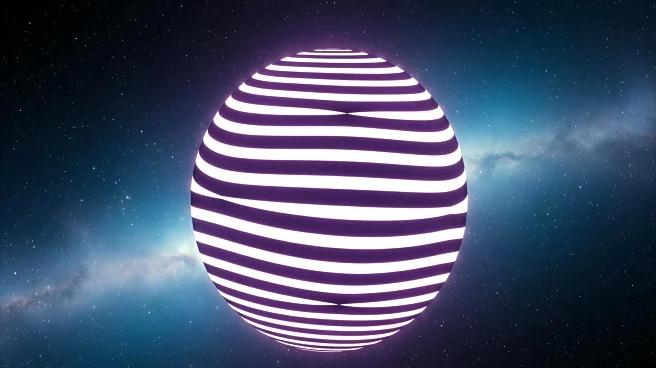
For over two decades, the Crab Pulsar's distinct pattern of bright, evenly spaced stripes in its radio waves has puzzled astronomers. Mikhail Medvedev, a theoretical astrophysicist at the University of Kansas, has proposed a solution that incorporates
gravity's lensing effect to fully explain this phenomenon. The Crab Pulsar, a dense remnant of a supernova, is located about 6,500 light-years from Earth in the Crab Nebula. Medvedev's research, which will be presented at the American Physical Society's 2026 Global Physics Summit, suggests that both gravity and plasma work together to shape the pulsar's signal. This is the first observed case where these two forces combine to affect a signal from space. The study, accepted by the Journal of Plasma Physics, highlights how gravity acts as a lens in curved spacetime, altering the path of light and creating the unique zebra stripe pattern.
Why It's Important?
This discovery is significant as it provides a new tool for studying neutron stars and their environments. Understanding the interaction between gravity and plasma in shaping cosmic signals can offer insights into the distribution of matter around neutron stars and their internal structures. The Crab Pulsar's unique signal, unlike any other pulsar, presents an opportunity to explore the effects of rotating gravitational systems. This research could lead to advancements in astrophysics by improving the precision of models used to study these celestial bodies. The findings may also enhance our understanding of supernova remnants and the broader cosmic environment.
What's Next?
Further research may focus on refining the model to include rotational effects of the pulsar, which could introduce quantitative changes to the current understanding. This could lead to more precise mapping of matter distribution around neutron stars. The study of the Crab Pulsar's zebra stripes may also inspire new investigations into other pulsars and cosmic phenomena, potentially revealing more about the universe's fundamental forces and structures.
Beyond the Headlines
The combination of gravity and plasma effects in the Crab Pulsar's signal represents a novel application of Einstein's theory of gravity. This research underscores the importance of interdisciplinary approaches in astrophysics, combining theoretical physics with observational data. The study also highlights the potential for gravitational lensing to reveal hidden aspects of the universe, offering a deeper understanding of cosmic phenomena that are otherwise difficult to observe directly.