



What's Happening?
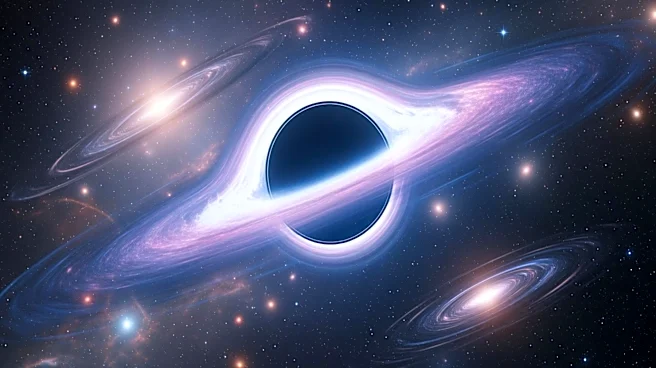
Astronomers have discovered a supermassive black hole, ULAS J1120+0641, that may have outgrown its host galaxy permanently. Observations from the James Webb Space Telescope reveal a system so unbalanced that future galaxy mergers are unlikely to restore
equilibrium. The black hole, a quasar seen as it existed 12.9 billion years ago, suggests that some black holes in the early universe grew rapidly, outpacing their galaxies. Despite being surrounded by potential neighboring galaxies, the host remains significantly outmatched. This discovery raises questions about how such imbalances formed and the role of cosmic fuel in black hole growth.
Why It's Important?
The findings challenge current understanding of black hole and galaxy co-evolution, suggesting that some black holes may have grown independently of their host galaxies. This has implications for models of galaxy formation and the distribution of matter in the universe. Understanding these early cosmic structures can provide insights into the conditions of the early universe and the processes that shaped its evolution. The study also highlights the capabilities of the James Webb Space Telescope in revealing faint, distant galaxies and advancing astrophysical research.
What's Next?
Future observations will focus on mapping hidden gas and faint companion galaxies to determine whether the system is fading or unfinished. Researchers will continue to explore the growth dynamics of black holes and their host galaxies, using advanced telescopes and simulations. The study of ULAS J1120+0641 will contribute to broader efforts to understand the balance between black holes and galaxies, and the factors influencing their development over cosmic time.