




What's Happening?
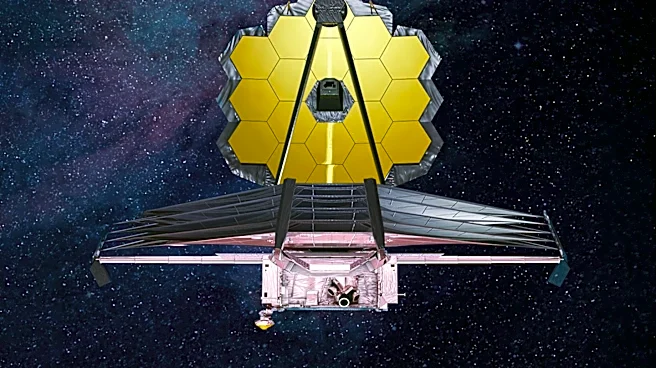
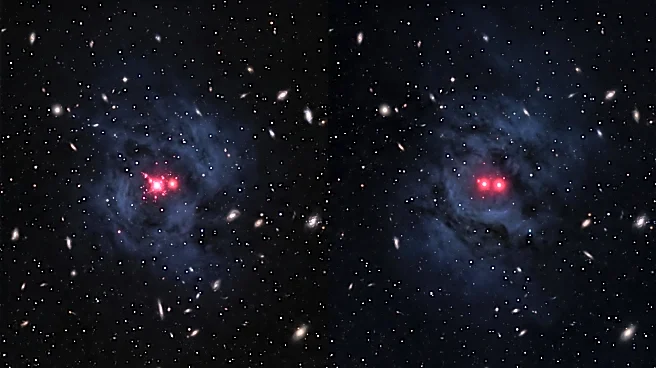
Astronomers utilizing the James Webb Space Telescope have identified four pairs of compact red dots in distant light sources, providing new insights into the early interactions of galaxies and supermassive black holes when the universe was approximately
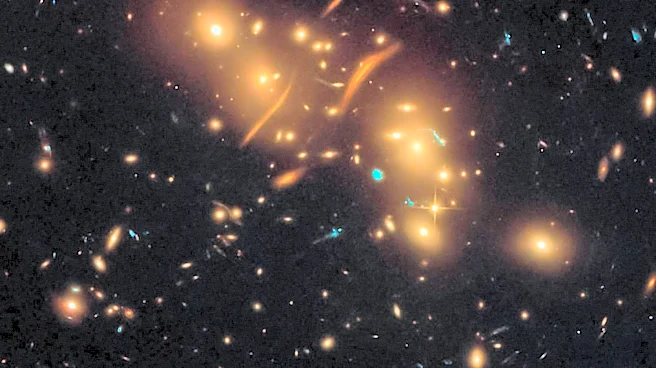
one billion years old. These 'little red dots' were initially observed as tiny, deep red, and compact objects in high-resolution infrared images. While many scientists hypothesize these dots represent active supermassive black holes accreting gas and dust, other research teams suggest they could be dense clusters of ancient stars. Lead researcher Takumi S. Tanaka and his team employed a pixel-by-pixel analysis of images from the COSMOS-Web deep-sky survey, revealing that what appeared as single light sources were, in fact, blended pairs. Two of these candidate pairs also showed spectroscopic evidence, specifically matching hydrogen-alpha gas signatures, indicating they share the same cosmic distance and physical region, though separated by thousands of light-years.
Why It's Important?
This discovery is crucial for understanding cosmic evolution during the universe's infancy. The identification of these closely paired objects suggests that early galaxies and black holes began congregating in the same cosmic neighborhoods much earlier than previously understood. While these pairs are thousands of light-years apart and not on the verge of collision, they represent an early developmental stage in the long gravitational process that can lead to black hole mergers. Such mergers are believed to be a significant mechanism for black hole growth. The statistical unlikelihood of these close pairings occurring by random alignment further supports the idea that they reflect real structural formations in the early universe. This data will help refine models of how supermassive black holes grow and how galaxies interact and evolve in the nascent cosmos.
What's Next?
The true physical nature of these 'little red dots' remains under study, with ongoing observations aiming to confirm whether they are supermassive black holes, dense clusters of stars, or a combination. While the discovery links early galaxy interactions with black hole growth, the current data cannot predict if or when these specific candidate pairs will merge. Astronomers require additional spectroscopic measurements and more refined physical models to draw firm conclusions about their ultimate fate. Future space observatories, such as the Laser Interferometer Space Antenna, are designed to detect gravitational waves that would be produced if two supermassive black holes eventually merge. Continued research on these four candidate pairs will be instrumental in refining our understanding of how the early universe took shape and how its most massive structures began to form.
Beyond the Headlines
The identification of these 'little red dots' opens new avenues for exploring the fundamental processes that governed the early universe. The debate over whether these objects are active black holes or star clusters highlights the challenges in interpreting observational data from such extreme cosmic distances and early epochs. If confirmed as dual black holes, these findings could provide critical insights into the seeds of supermassive black holes and their co-evolution with galaxies. The existence of such close pairings so early in cosmic history suggests that the mechanisms driving galaxy assembly and black hole growth were highly efficient. This research pushes the boundaries of our understanding of cosmic structure formation, potentially revealing a more dynamic and interconnected early universe than previously envisioned, with implications for the eventual distribution of galaxies and dark matter.