



What's Happening?
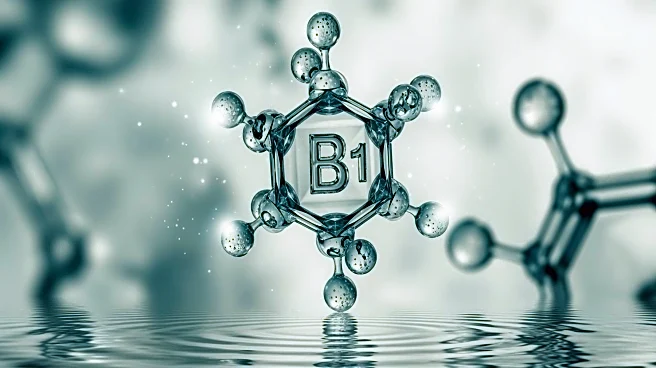
A team of chemists at UC Riverside has successfully stabilized a highly reactive molecule known as a carbene in water, providing direct evidence for a vitamin B1 theory proposed in 1958 by Columbia University chemist Ronald Breslow. Carbenes are typically
unstable in water, but the team, led by Vincent Lavallo, managed to create a water-stable carbene using a protective carborane-based framework. This breakthrough confirms Breslow's hypothesis that vitamin B1 (thiamine) can form a carbene-like intermediate in metabolic processes. The research utilized nuclear magnetic resonance (NMR) spectroscopy and X-ray crystallography to confirm the stability and structure of the carbene.
Why It's Important?
This discovery has significant implications for both biochemistry and industrial chemistry. It demonstrates that carbenes, which are crucial in many enzymatic reactions, can exist in aqueous environments if properly stabilized. This could lead to advancements in understanding metabolic processes involving vitamin B1. Additionally, the ability to stabilize carbenes in water opens up possibilities for greener industrial processes. Carbenes are used in metal catalysts for pharmaceutical and materials synthesis, and stabilizing them in water could reduce reliance on toxic organic solvents, promoting more environmentally friendly manufacturing practices.
What's Next?
The research team plans to explore the application of their stabilization technique to other reactive intermediates, potentially allowing for direct observation and study of these species. This could lead to new insights into reaction mechanisms and the development of more efficient catalysts. The findings may also inspire further research into enzyme microenvironments and their role in stabilizing reactive intermediates, potentially leading to new biotechnological applications.