



What's Happening?
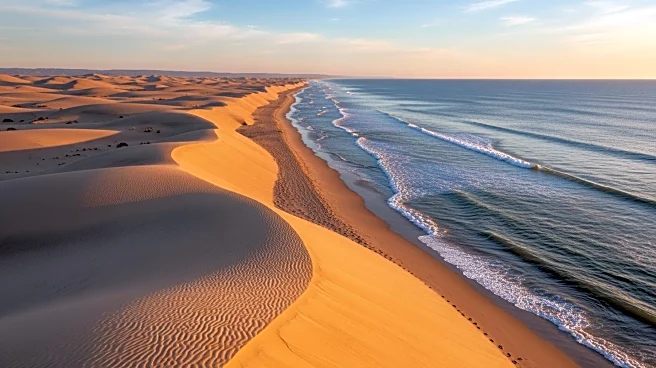
Deserts such as the Atacama in Chile and the Namib in southern Africa are located next to oceans, a phenomenon explained by several scientific factors. According to David Kreamer, a hydrologist at the University of Nevada, Las Vegas, these factors include
vertical and horizontal air movement and the interaction of mountain ranges with air moisture. The equator's direct sunlight causes air to rise, creating low-pressure systems that lead to rain in equatorial regions. However, as this air moves and sinks between 20 and 40 degrees latitude, it suppresses cloud formation, resulting in deserts. Additionally, trade winds and cold ocean currents contribute to the dryness of these coastal deserts.
Why It's Important?
Understanding the formation of coastal deserts is crucial for comprehending global climate patterns and their impact on ecosystems. These deserts, despite their proximity to water, have unique climates and biodiversity, with species adapted to capture moisture from fog. This knowledge can inform environmental conservation efforts and the development of sustainable practices in arid regions. Furthermore, studying these deserts can provide insights into climate change, as shifts in atmospheric and oceanic patterns could alter their characteristics, affecting local and global ecosystems.
What's Next?
Future research may focus on the impact of climate change on coastal deserts, particularly how rising temperatures and changing wind patterns could affect their ecosystems. Scientists may also explore innovative ways to harness moisture from fog, inspired by the natural adaptations of desert species. This could lead to new technologies for water collection in arid regions, addressing water scarcity issues. Additionally, there may be increased interest in studying the role of deserts in the global carbon cycle and their potential to influence climate regulation.
Beyond the Headlines
The study of coastal deserts highlights the complex interplay between natural forces and the environment. It raises questions about human adaptation to changing climates and the potential for technological innovations inspired by nature. The unique ecosystems of these deserts offer opportunities for scientific discovery and the development of sustainable solutions to environmental challenges. This research also underscores the importance of preserving biodiversity and understanding the delicate balance of Earth's ecosystems.