







What's Happening?
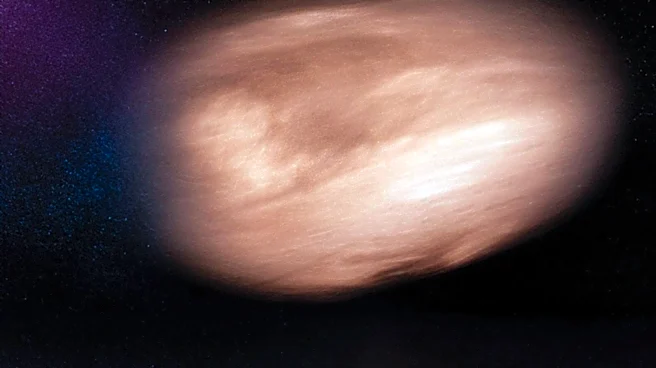
Astronomers have, for the first time, measured both the mass and distance of a rogue planet, located 9,800 light-years away, using microlensing techniques. The planet, with a mass comparable to Saturn, drifts through the galaxy without a star to orbit.
This breakthrough was achieved by observing the same microlensing event from two different locations, allowing scientists to resolve the mass-distance degeneracy that has previously hindered such measurements. The findings suggest that the Milky Way may contain billions, possibly trillions, of similar rogue planets.
Why It's Important?
This discovery provides a new method for studying rogue planets, which are believed to be abundant in the galaxy. Understanding these planets can offer insights into planetary formation and the dynamics of planetary systems. The ability to measure their mass and distance accurately opens up new possibilities for exploring these mysterious objects, which could have formed in various ways, including being ejected from their original systems.
What's Next?
Future missions, such as NASA's Nancy Grace Roman Space Telescope, are expected to survey the galactic bulge and potentially discover more rogue planets. These missions will help determine whether different formation processes leave distinct signatures, enhancing our understanding of planetary evolution. The continued study of rogue planets could reveal more about the diversity and complexity of planetary systems in the galaxy.
Beyond the Headlines
The study highlights the potential for new observational techniques to revolutionize our understanding of the universe. It also raises questions about the processes that lead to the formation and ejection of rogue planets, challenging existing models of planetary system dynamics. As more rogue planets are discovered, scientists will be able to refine their theories and gain a deeper understanding of the galaxy's hidden population of starless worlds.