



What's Happening?
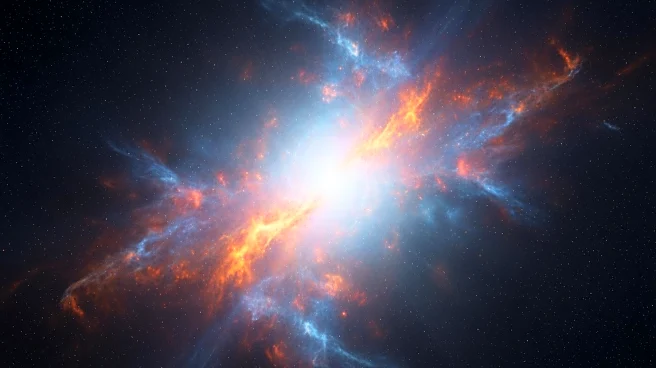
NASA's Hubble Space Telescope has captured a rare astronomical event involving the Calabash Nebula. The image reveals a low-mass star undergoing a rapid transformation from a red giant to a planetary nebula. During this process, the star expels its outer
layers of gas and dust into space at high speeds, with the gas moving at nearly a million kilometers per hour. This phase of stellar evolution is seldom observed due to its brief duration in astronomical terms. The nebula is expected to evolve into a fully-fledged planetary nebula over the next thousand years.
Why It's Important?
The observation of such a rare event provides valuable insights into the life cycle of stars, particularly the transition phases that are not often witnessed. Understanding these processes can enhance scientific knowledge about stellar evolution and the formation of planetary nebulae. This information is crucial for astronomers studying the lifecycle of stars and the dynamics of nebulae, contributing to broader astrophysical research and potentially informing future space exploration missions.