







What's Happening?
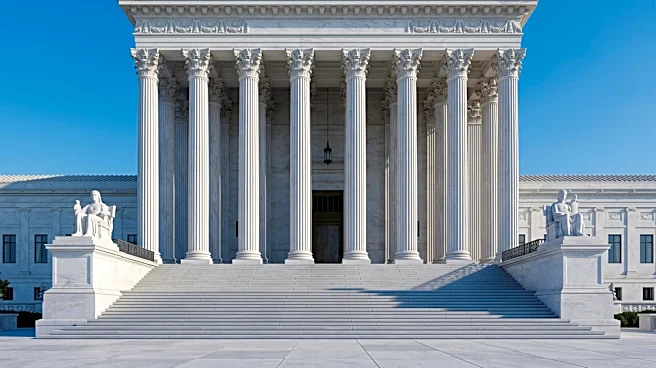
Twenty state Attorneys General have filed an amicus brief with the U.S. Supreme Court, supporting Missouri's request to temporarily block a Missouri Supreme Court ruling concerning the state's congressional map. The Missouri Supreme Court had ruled that
the 2022 congressional map must be used for the upcoming November election, while voters decide on a new map. The amicus brief, led by Florida and Texas, argues against changing electoral rules close to an election, citing the 'Purcell principle.' This principle suggests that courts should avoid making drastic changes to voting or election rules too close to an election to prevent voter confusion and administrative difficulties. The brief contends that implementing a new map now could lead to candidates running in different areas than where they were primaried, voters casting ballots for candidates they did not nominate, and state officials struggling to administer a different election than initially planned.
Why It's Important?
This intervention by 20 states underscores a significant national concern regarding election integrity and the timing of judicial decisions impacting electoral processes. The 'Purcell principle' is a critical legal doctrine that aims to prevent last-minute disruptions to elections, which could undermine public confidence and create logistical chaos. The involvement of numerous state Attorneys General, predominantly Republican, highlights a broader political and legal strategy to influence how congressional districts are drawn and implemented, particularly in the lead-up to federal elections. The outcome of this case could set a precedent for how state supreme court rulings on redistricting are challenged and potentially overturned by the U.S. Supreme Court, impacting the stability and predictability of election administration across the country. It also reflects ongoing tensions between state and federal judicial powers in electoral matters.
What's Next?
The U.S. Supreme Court will now consider Missouri's request for a stay, supported by the amicus brief from the 20 states. The Court's decision will determine whether the 2022 congressional map will be used in Missouri's upcoming November election or if the state will proceed with a different map. A ruling in favor of the stay would uphold the 'Purcell principle' and prevent a last-minute change to the electoral landscape. Conversely, denying the stay would mean the Missouri Supreme Court's decision stands, potentially leading to the administrative challenges and voter confusion outlined in the amicus brief. This case is likely to be closely watched by election officials, political parties, and legal scholars nationwide, as it could influence future challenges to redistricting decisions and the application of the 'Purcell principle' in other states.
Beyond the Headlines
The legal battle over Missouri's congressional map, now escalated to the U.S. Supreme Court with the backing of 20 states, reveals deeper implications for the balance of power in American elections. Beyond the immediate impact on Missouri voters and candidates, this case touches upon the broader debate surrounding judicial activism versus judicial restraint in electoral matters. The 'Purcell principle' itself is a subject of ongoing legal interpretation, and its application in this instance could either solidify its role as a safeguard against election disruption or open avenues for more frequent federal intervention in state-level electoral disputes. The alignment of 20 states, primarily with Republican Attorneys General, also highlights the partisan nature of redistricting and the strategic use of legal challenges to shape electoral outcomes. This case could contribute to the evolving legal framework governing redistricting and election administration, potentially influencing future legislative and judicial actions across the U.S.