



What's Happening?
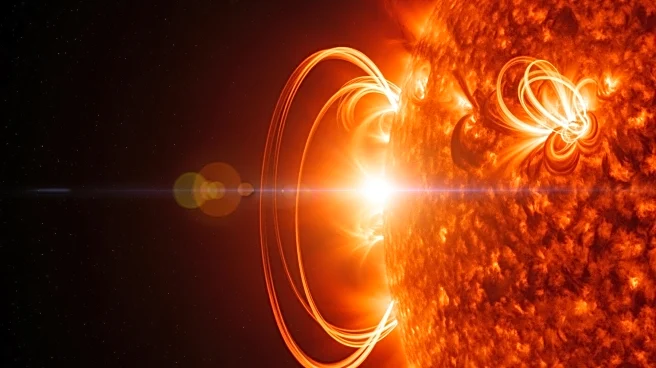
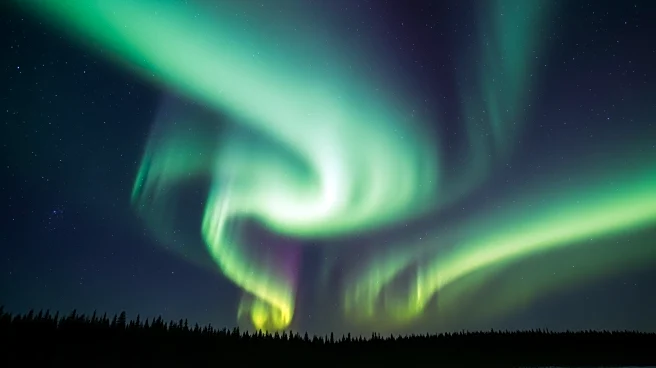
The National Oceanic and Atmospheric Administration (NOAA) has forecasted that the aurora borealis, commonly known as the northern lights, will be visible in 15 U.S. states this week. This prediction follows a significant X1.4-class solar flare that erupted
from the sun on March 29, captured by NASA's Solar Dynamics Observatory. The solar flare originated from a magnetically complex region of the sun, known as region 4405, and was accompanied by a coronal mass ejection (CME). This CME is expected to interact with Earth's geomagnetic field, potentially creating visible auroras. While the auroras may not be particularly strong, they are anticipated to be visible in states such as Alaska, Washington, Montana, North Dakota, Minnesota, and the northern parts of Wisconsin. Residents in other states like Wyoming, South Dakota, Idaho, Iowa, Michigan, New York, Vermont, New Hampshire, and Maine may also catch a glimpse if they are in elevated areas and face north.
Why It's Important?
The visibility of the aurora borealis in the U.S. is a rare and captivating natural phenomenon that draws significant public interest. This event provides an opportunity for residents in northern states to experience the beauty of the northern lights without traveling to typically more accessible locations like Alaska or Canada. The occurrence of such solar flares and their effects on Earth also highlight the importance of monitoring solar activity, as these events can impact radio communications and GPS systems. The recent solar flare caused a temporary R3-level radio blackout, affecting high-frequency radio communications and navigation satellite signals, primarily in sunlit regions like Australia and Southern Asia. Understanding and predicting these solar events are crucial for mitigating their potential disruptions to technology and communication systems.
What's Next?
As the aurora borealis is expected to be visible over the next couple of days, residents in the affected states are encouraged to find locations away from city lights and look towards the northern horizon for the best viewing experience. The NOAA will continue to monitor solar activity and provide updates on any further developments. This event may also prompt increased interest in space weather research and public engagement with astronomical phenomena. Additionally, the impact of solar flares on communication systems may lead to further studies and advancements in technology to better withstand such disruptions in the future.