








What's Happening?
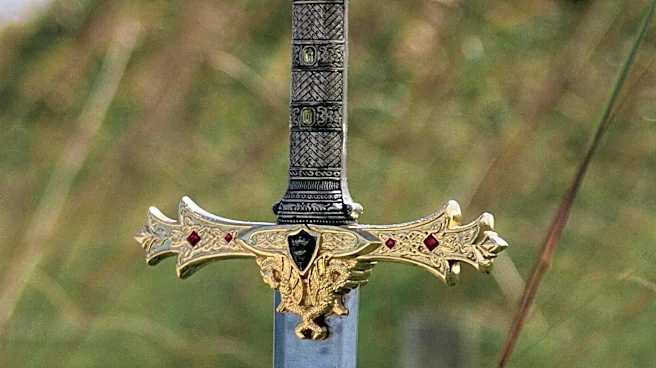
The term 'Sword of the Sea' is primarily referenced in the context of mythological significance and ancient legends. Specifically, it is associated with the Kusanagi-no-Tsurugi, a legendary sword deeply embedded in Japanese mythology. This mythical weapon
is famously depicted as being discovered within the tail of the formidable eight-headed serpent, Yamata no Orochi. The hero Yamato Takeru is credited with wielding this sword, which plays a crucial role in various Japanese folk tales and historical narratives. The sources provided do not indicate the existence of a specific, tangible 'Sword of the Sea' item or a contemporary event related to such a sword, but rather focus on its legendary status and cultural importance within mythological frameworks. The references highlight the enduring nature of such legends in cultural storytelling.
Why It's Important?
The importance of the 'Sword of the Sea' and its connection to the Kusanagi-no-Tsurugi lies in its profound cultural and historical resonance, particularly within Japanese heritage. Such mythological artifacts often serve as foundational elements in national identity, influencing art, literature, and traditional beliefs. For the U.S., understanding these global cultural touchstones is important for fostering international relations and appreciating diverse cultural narratives. While not directly impacting U.S. industries or politics, the study of such legends contributes to academic fields like comparative mythology and cultural studies, which are pursued in U.S. educational institutions. It also enriches the understanding of global storytelling traditions, which can indirectly influence entertainment and media industries that draw inspiration from diverse mythologies. The enduring nature of these stories underscores the human fascination with heroic sagas and powerful symbols.
What's Next?
Given that the 'Sword of the Sea' is primarily a mythological concept, there are no immediate 'next steps' in terms of real-world events or policy decisions. However, its cultural significance is likely to continue to be explored and reinterpreted in various forms. This could include further academic research into its origins and impact on Japanese culture, new adaptations in literature, film, or video games, and continued discussions within cultural preservation efforts. For instance, museums or cultural institutions might feature exhibitions on legendary artifacts, including the Kusanagi-no-Tsurugi, to educate the public on its historical and mythological importance. The ongoing interest in such legends ensures their perpetuation through generations, maintaining their relevance as cultural symbols.
Beyond the Headlines
Beyond its literal interpretation, the 'Sword of the Sea' embodies deeper cultural and ethical dimensions. It represents themes of heroism, divine intervention, and the struggle between good and evil, which are universal in human storytelling. The legend of Kusanagi-no-Tsurugi, as a 'Sword of the Sea,' also highlights the profound connection between ancient cultures and natural elements, particularly the ocean, which is often seen as a source of both life and mystery. This connection can inspire contemporary discussions on environmental stewardship and the preservation of natural heritage. Furthermore, the concept of a powerful, legendary weapon often raises questions about power, responsibility, and the consequences of wielding immense force, themes that remain relevant in modern ethical and philosophical discourse.