






What's Happening?
A new analysis published in the journal Earth-Science Reviews indicates that climate change, through rising temperatures and altered weather patterns, could significantly exacerbate the risk of toxic mining waste contaminating marine environments. The
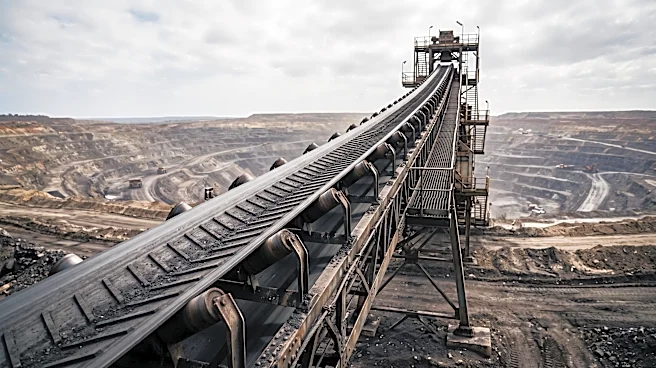
study identified that metal mines and their waste storage facilities pose a pollution threat to nearly 293,000 kilometers (182,000 miles) of coastline globally. Researchers examined areas where compounding risks from warmer temperatures, rising seas, and changing weather patterns could release more toxic waste over the next century. The analysis highlights that the long-term release of toxic waste from inactive mines presents a larger global challenge than the failure of dams holding mining waste, known as tailings. Six high-risk regions were identified: North America, South America, Northern Europe, the Mediterranean, East Asia, and Australia. The study used a worst-case climate modeling scenario (RCP8.5) to project these impacts, showing that temperate zones could see a substantial increase in active and inactive mines and tailings storage facilities experiencing warmer summers, leading to more erosion and thawing that releases toxic waste. Additionally, changes in rain and wind patterns could either increase pollution washing into watersheds or heighten the potential for waste to dry out and be blown away. All mines in the database are near coastlines expected to experience significant sea level rise, potentially flooding contaminated sediment and eroding coastlines.
Why It's Important?
This study is important because it underscores a critical, yet often overlooked, environmental threat amplified by climate change: the widespread contamination of coastal waters by mining waste. The findings have significant implications for the health of marine ecosystems, which billions of people rely on for food and livelihoods. The potential for increased metal buildup in the food chain due to higher sea levels and storm surges, coupled with ocean acidification from mining waste chemicals, could severely impact human health and coastal economies. The analysis also highlights the financial and political challenges associated with remediating long-term pollution from inactive mines, which often lack a responsible party for cleanup. The identified hotspots, including North and South America, indicate a direct threat to U.S. coastal regions and their communities. The study emphasizes the need for proactive monitoring and mitigation strategies to protect vulnerable areas, suggesting that current practices may be insufficient to address the escalating risks posed by climate change to mining sites.
What's Next?
To address the escalating risks, researchers recommend enhanced monitoring in high-risk locations, utilizing tools like satellite observation and on-the-ground sampling to model marine contamination. For already polluted areas, proposed solutions include dredging, covering, or stabilizing contaminated sediment, and planting vegetation like mangroves or marsh grasses to draw metals from the water. The study also urges the adoption of best available practices for new and existing mines, such as filtering or burying mining waste and reinforcing dam walls, to prevent contamination. However, financial and political hurdles remain significant, particularly for inactive legacy mines where accountability for cleanup is often unclear. The U.N. has proposed a global mining legacy fund to tackle the challenges posed by abandoned mines. Experts also suggest reducing the overall demand for metals and implementing best practices as key steps to minimize risks to coastal environments, acknowledging that mining inherently carries risks and pollution.
Beyond the Headlines
The study's findings reveal a deeper ethical and systemic challenge: the legacy of industrial activity intersecting with the accelerating impacts of climate change. The sheer scale of the problem, with nearly 293,000 kilometers of coastline at risk, points to a global environmental debt that transcends national borders and corporate lifespans. The difficulty in holding responsible parties accountable for inactive mines highlights a gap in environmental governance and corporate responsibility. This issue also touches upon environmental justice, as coastal communities, often including Indigenous populations and communities of color, are disproportionately affected by pollution. The call for a global mining legacy fund suggests a recognition that this is a collective problem requiring international cooperation and innovative financial mechanisms. Ultimately, the study prompts a re-evaluation of the true cost of metal extraction and consumption, pushing for a shift towards more sustainable practices and a circular economy to mitigate future environmental and health crises.