



What's Happening?
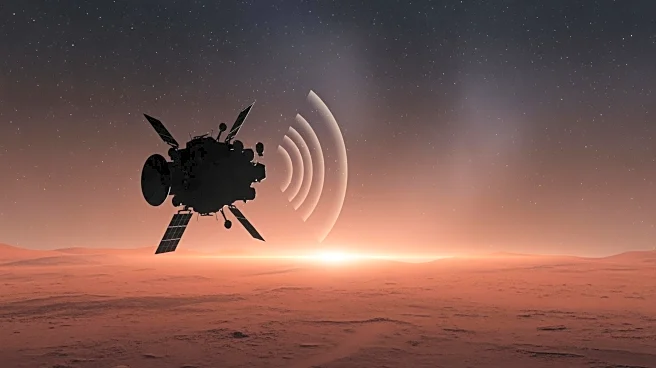
NASA's MAVEN Mars orbiter, which has been studying the Martian atmosphere since 2014, lost contact with Earth on December 6, 2025. The loss of signal occurred as MAVEN passed behind Mars, and no communication was received when it reappeared. NASA confirmed
the anomaly on December 9, 2025, and is actively investigating the issue. MAVEN plays a crucial role in studying Mars' upper atmosphere and serves as a communications relay for the Curiosity and Perseverance rovers. The spacecraft's sudden silence has raised concerns about the continuity of Mars missions, as it is a key component of the communications network linking Earth to Mars.
Why It's Important?
The loss of contact with MAVEN is significant because it affects both scientific research and communication capabilities for Mars missions. MAVEN's data has been instrumental in understanding Mars' atmospheric evolution and its transition from a potentially habitable environment to its current state. Additionally, MAVEN's role as a communications relay is vital for transmitting data from Mars rovers back to Earth. If MAVEN remains offline, the bandwidth and scheduling flexibility for data transmission could be reduced, impacting the efficiency of ongoing Mars missions. This incident highlights the fragility of the aging Mars communications network and underscores the need for a new telecommunications orbiter.
What's Next?
NASA is working to diagnose the cause of the communication loss and is exploring options to recover the MAVEN mission. The agency has experience in reviving troubled spacecraft, and efforts are underway to listen for any signals from MAVEN. Meanwhile, other orbiters like Mars Reconnaissance Orbiter and Mars Odyssey will continue to support communication with Mars rovers. However, the long-term solution may involve accelerating plans for a new Mars telecommunications orbiter to ensure robust communication capabilities for future missions.
Beyond the Headlines
The MAVEN anomaly brings attention to the broader issue of maintaining a reliable communications infrastructure for Mars exploration. With existing orbiters aging, the need for a new, high-performance telecommunications orbiter becomes more pressing. Such an orbiter could enhance data transmission capabilities and support future Mars missions, including potential human exploration. The situation also emphasizes the importance of redundancy in space missions, as the loss of a single orbiter can significantly impact mission operations and scientific research.