







What's Happening?
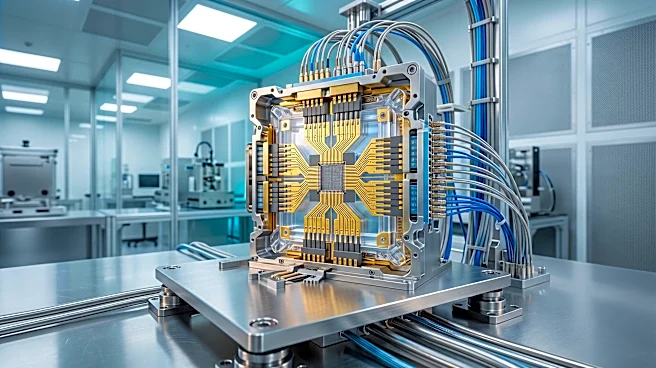
IBM has announced its next-generation quantum processor, the IBM Quantum Nighthawk r3, designed to execute 10,000 quantum operations across 520 qubits. This new processor aims to tackle larger and more complex computational problems while maintaining
the speed and quality demonstrated by its predecessor, the Nighthawk r2. The Nighthawk r2, introduced in September, delivers up to 100,000 samples per second and supports accurate computations with over 7,500 quantum operations on 120 qubits. Clients and partners, including E.ON, Algorithmiq, and Q-CTRL, have already run billions of circuits on Nighthawk r2, reporting significant speedups. IBM plans to link two Nighthawk r3 processors into a single system with more than 1,000 qubits by 2027, extending its high-performance architecture to even larger and more complex computations. This development is part of IBM's roadmap toward achieving fault-tolerant quantum systems.
Why It's Important?
The advancement of IBM's Nighthawk processors is crucial for the progression of quantum computing, particularly in achieving utility-scale systems. The ability to execute more quantum operations across a larger number of qubits with increased speed and accuracy directly addresses the current limitations of quantum computers. This progress is vital for industries that rely on complex computations, such as drug discovery, materials science, and financial modeling. Faster and more reliable quantum systems could significantly accelerate research and development in these sectors, leading to breakthroughs that are currently impossible with classical computing. The integration of quantum and classical computing resources, as highlighted by IBM, is also a key step towards making quantum technology practical and accessible for real-world applications, potentially transforming how businesses and researchers approach computationally intensive problems.
What's Next?
IBM's immediate next step involves the development and deployment of the Nighthawk r3 processor, with a clear goal of connecting two r3 processors to create a single system exceeding 1,000 qubits by 2027. This will enable more complex computations and further push the boundaries of quantum capabilities. The company is also focusing on enhancing the integration of quantum and high-performance classical computing within its IBM Quantum Platform, allowing users to combine quantum workflows with powerful classical resources. This hybrid approach is expected to fuel breakthroughs in quantum error correction, giving researchers more precise control over error detection and correction. Furthermore, IBM is collaborating with institutions like Oak Ridge National Laboratory and AMD to co-locate Nighthawk with HPC systems, aiming to accelerate the development of fault-tolerant quantum computers and their practical applications.
Beyond the Headlines
The continuous development of quantum processors like IBM's Nighthawk series has profound implications beyond immediate computational gains. The pursuit of fault-tolerant quantum computing, where errors can be reliably corrected, is a critical step towards unlocking the full potential of this technology. This could lead to a paradigm shift in scientific discovery and technological innovation, enabling the simulation of complex molecular structures for new drugs, the design of advanced materials with unprecedented properties, and the optimization of intricate systems like supply chains and financial markets. However, the ethical and societal implications of such powerful computing capabilities, including potential impacts on data security and the need for responsible development, will become increasingly important considerations as quantum technology matures.