






What's Happening?
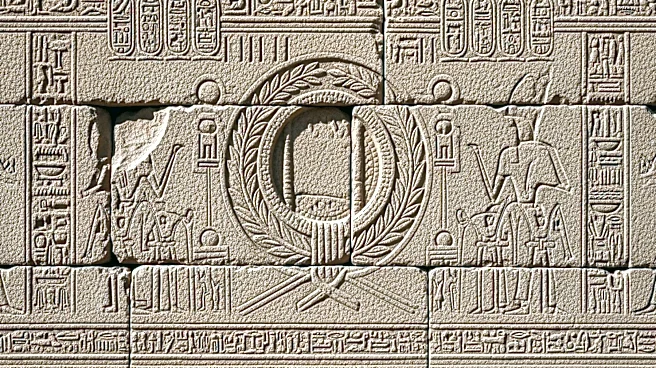
Archaeologists in Egypt have uncovered a 2,000-year-old sandstone monument depicting Roman Emperor Tiberius as a pharaoh. The monument, known as a stela, was found during restoration work at the Karnak temple complex in Luxor. Measuring approximately
23.6 by 15.7 inches, the stela dates back to Tiberius' rule from A.D. 14 to 37. The depiction of Tiberius alongside Egyptian deities Amun, Mut, and Khonsu highlights his role in maintaining ma'at, the principle of cosmic order in ancient Egyptian religion. This representation was common in religious settings, allowing Roman emperors to be integrated into Egypt's religious system while retaining their Roman style in coins and official statues.
Why It's Important?
The discovery of the stela is significant as it sheds light on the cultural and religious integration between the Roman Empire and ancient Egypt. By portraying Tiberius as a pharaoh, the monument reflects the ideological and administrative systems of the time, where emperors were seen as protectors of temples and religious institutions. This integration helped preserve Egypt's religious traditions under Roman rule, demonstrating the adaptability and continuity of cultural practices despite political changes. The stela also provides insights into the historical context of Roman rule in Egypt, following the province's incorporation into the empire after the defeat of Cleopatra VII and Mark Antony.
What's Next?
The stela will be displayed in a museum, allowing the public to view this historical artifact. The ongoing restoration work at the Karnak temple complex may lead to further discoveries, enhancing our understanding of the interactions between Roman and Egyptian cultures. Researchers will continue to study the stela to gain deeper insights into the religious and political dynamics of the era. The monument's preservation and public display will contribute to cultural heritage and education, offering a tangible connection to the ancient world.