




What's Happening?
Hung Cao is currently serving as the Acting Secretary of the Navy, having assumed the role on April 22. His nomination by President Trump to become the 80th Secretary of the Navy was formally transmitted to the Senate on September 14. Cao's tenure as Acting Secretary has
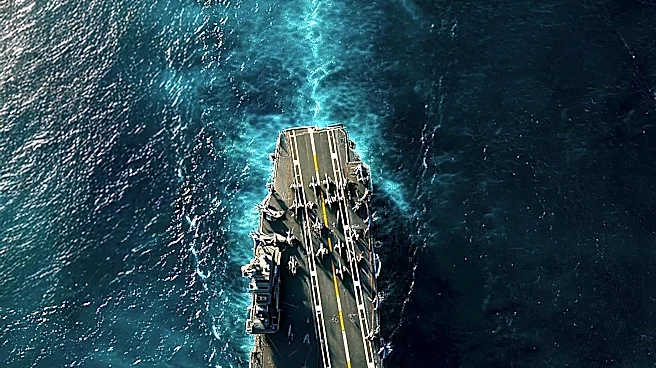
coincided with U.S. forces conducting combat operations against Iran in 'Operation Epic Fury,' which includes a naval blockade of Iranian ports and other combat activities. During this period, Cao has focused on maintaining combat power at sea, replacing expended weapons, and sustaining Sailors and Marines. His priorities, as stated to the Senate Armed Services Committee, include taking care of service members, advancing shipbuilding, and defending the homeland. The fiscal year 2027 Shipbuilding Plan, defended by Cao, emphasizes disciplined execution, expanding shipyard and workforce capacity, revitalizing the industrial base, and reforming acquisition processes. He has also made key leadership appointments, including William Toti as Under Secretary and Richard Breckenridge as senior adviser for shipbuilding, who has since been nominated as Assistant Secretary of the Navy for Research, Development, and Acquisition. Cao's approach involves 'leadership by presence,' placing acquisition leaders closer to production sites to address issues directly. Notably, he announced a $22.9 billion Raytheon award in August to accelerate missile deliveries and reduce procurement lead times, and in September, the Navy selected three shipyards for LCU 1700 landing craft prototypes to broaden shipbuilding capacity.
Why It's Important?
The ongoing situation highlights the critical need for robust U.S. maritime power, especially during active combat operations. The efforts led by Acting Secretary Cao are crucial for ensuring the Navy's readiness and long-term capabilities. Rebuilding commercial shipping and shipbuilding, expanding the maritime workforce, and strengthening the broader industrial foundations are vital for national security and economic stability. The bipartisan Congressional Guidance for a National Maritime Strategy, co-authored by Representatives Michael Waltz (R-FL) and John Garamendi (D-CA) and Senators Mark Kelly (D-AZ) and Marco Rubio (R-FL), underscores the national consensus on reversing the decline of America’s maritime power. President Trump's executive order in 2025, directing a government-wide Maritime Action Plan, further emphasizes the strategic importance of this initiative. The plan treats the maritime industrial base as an ecosystem encompassing commercial and defense shipbuilding, repair, transportation, infrastructure, workforce, and finance, aiming to attract private capital into American shipyards. The administration's focus on a fifth public Navy Yard, reform of Naval Sea Systems Command (NAVSEA), and pathways for allied shipbuilders to invest in American production signifies a comprehensive approach to bolstering the nation's maritime industrial base. These actions have significant implications for U.S. industries, creating demand for shipbuilding, manufacturing, and a skilled workforce, while also enhancing the nation's ability to project power and protect its interests globally.
What's Next?
The Senate is currently considering Hung Cao's nomination for Secretary of the Navy. A procedural hurdle exists due to a statutory cooling-off period for retired military officers assuming such a role, which requires a specific congressional exception. Congress has enacted similar exceptions for other senior defense positions in the past, notably for Secretaries of Defense. If confirmed, Cao is expected to continue implementing the strategies he has initiated as Acting Secretary, focusing on sustained readiness, shipbuilding expansion, and industrial base revitalization. The administration's broader maritime agenda, including the development of a government-wide Maritime Action Plan and measures to expand naval shipbuilding and repair, will likely proceed. This includes plans for a fifth public Navy Yard, further reforms of NAVSEA, and new acquisition approaches. The 'Ten Ships' initiative, aimed at recapitalizing America’s strategic sealift fleet, will serve as a practical test of the model articulated by Cao's leadership team, requiring alignment across various government agencies, Congress, industry, and private capital. The outcome of Cao's nomination and the continued execution of these maritime strategies will shape the future of U.S. naval power and its supporting industrial infrastructure.
Beyond the Headlines
The situation surrounding Acting Secretary Cao's nomination and his leadership during wartime operations highlights deeper implications regarding the intersection of military readiness, industrial capacity, and political processes. The need for a congressional waiver for Cao's appointment underscores the tension between civilian control of the military and the desire to leverage experienced military leadership in critical roles. This procedural challenge, set against the backdrop of active combat, brings into focus the complexities of national security decision-making. Furthermore, the emphasis on rebuilding the maritime industrial base points to a long-term shift in U.S. defense policy, recognizing that military strength is not solely dependent on advanced weaponry but also on the underlying industrial capacity to produce and maintain it. This involves ethical considerations regarding the balance between government investment and private sector involvement, as well as the potential for long-term economic impacts on regions with shipbuilding and manufacturing industries. The 'leadership by presence' approach adopted by Cao suggests a cultural shift towards more direct engagement and accountability within defense procurement and production, aiming to bridge the gap between strategic planning and operational execution. The success of these initiatives will not only determine the future of the U.S. Navy but also influence the broader economic and technological landscape of the nation.