








What's Happening?
A federal appeals court has sided with the Trump administration regarding changes to the Department of Housing and Urban Development's (HUD) funding policy for homeless programs. The First Circuit Court of Appeals granted HUD's request to stay a lower
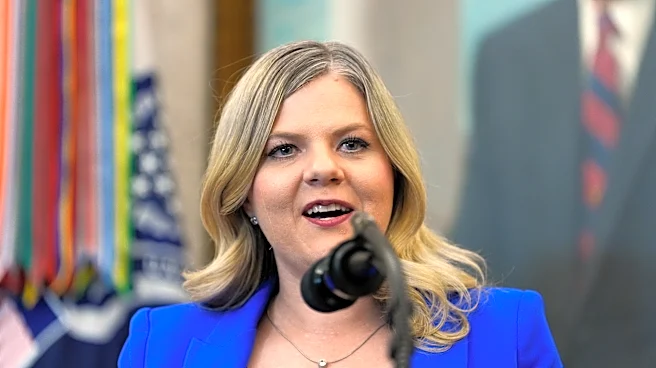
court ruling that had blocked these changes, allowing them to move forward while a legal challenge from states, including Maine, continues. The dispute centers on HUD’s FY 2026 Continuum of Care Notice of Funding Opportunity, which allocates over $4 billion for homelessness programs. Specifically, $1.3 billion of this funding is now set aside for new projects, prioritizing transitional housing and supportive-service projects. HUD states that these changes aim to address the root causes of homelessness by directing funds towards organizations that facilitate treatment and recovery, while prohibiting funding for illicit drug use and paraphernalia distribution. HUD Secretary Turner has called the ruling a 'win for taxpayers,' emphasizing a shift away from the previous 'housing first' model, which he claims failed by not requiring preconditions like sobriety or employment.
Why It's Important?
This decision is significant as it allows HUD to implement a revised approach to homelessness funding, potentially altering how states and local organizations address the issue. By prioritizing transitional housing and supportive services, HUD is shifting focus from simply providing housing to integrating treatment and recovery programs. This could lead to a reallocation of resources, with some existing programs that do not align with the new priorities potentially losing funding. States like Maine, which are part of the legal challenge, argue that these changes could make it harder to provide certain services, potentially impacting vulnerable populations. The emphasis on performance and outcomes, rather than automatic renewals, introduces a more competitive environment for funding, aiming to ensure that taxpayer dollars are used effectively to achieve self-sufficiency for homeless individuals. This move reflects a broader policy shift under the Trump administration to reform social programs by tying funding to specific outcomes and accountability.
What's Next?
The legal challenge against HUD's funding changes is ongoing, despite the First Circuit Court of Appeals allowing the changes to proceed. The plaintiffs, a coalition of states, have expressed disappointment, stating that the decision could undermine permanent housing solutions and potentially increase homelessness. HUD has a deadline of December 1, 2026, to make Continuum of Care awards, meaning the new funding priorities will likely be implemented in the upcoming allocation cycle. Organizations like Maine’s Continuum of Care will need to adapt to the new competitive landscape, working with providers, state partners, and community stakeholders to ensure they remain competitive for federal resources. Further legal actions or appeals from the challenging states are possible as they continue to advocate for their preferred strategies in addressing homelessness. The long-term impact of these funding changes on homelessness rates and the effectiveness of recovery-focused programs will be closely monitored.
Beyond the Headlines
The debate over HUD's funding changes highlights a fundamental philosophical difference in addressing homelessness: whether to prioritize immediate housing solutions (housing first) or to focus on treatment and recovery services as a prerequisite for stable housing. Secretary Turner's criticism of the 'housing first' model as a 'failed experiment' suggests a broader ideological shift within the Trump administration regarding social welfare programs. This shift could have profound ethical and social implications, potentially impacting the most vulnerable populations who may struggle to meet new preconditions for assistance. The emphasis on 'self-sufficiency' and 'merit and outcomes' also raises questions about the role of government in providing social safety nets and the balance between accountability and compassion. This policy change could trigger a re-evaluation of best practices in homelessness intervention across the nation, potentially leading to new models of care and support, but also risking increased hardship for those unable to navigate the new system.