




What's Happening?
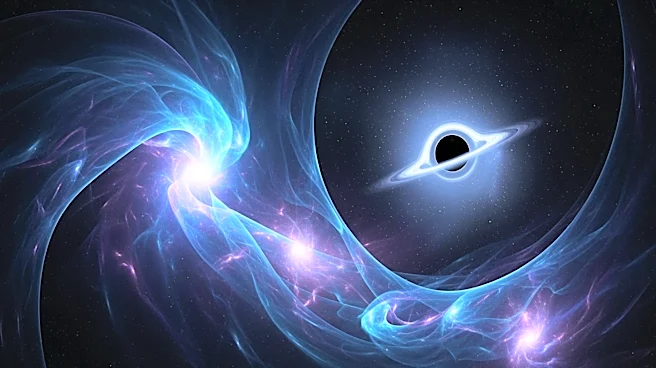
Astronomers from the Center for Astrophysics at Harvard University and the Smithsonian Institution have observed how interstellar turbulence distorts light in the interstellar medium. This discovery is significant for improving the clarity of images of supermassive
black holes, such as Sagittarius A* at the center of the Milky Way. The study focused on the quasar TXS 2005+403, whose radio waves are distorted as they pass through the turbulent Cygnus region of the Galaxy. This turbulence causes scattering, which affects the resolution of black hole images. The team is conducting follow-up observations using the NSF VLBA radio astronomy network to measure the properties of this turbulence.
Why It's Important?
The findings are crucial for astronomical research, particularly in enhancing the resolution of black hole images. The turbulence detected is on a scale comparable to our Solar System, providing insights into energy distribution and gas behavior in the galaxy. Understanding these dynamics is essential for studying star formation and the structure of the universe. The research could lead to clearer images of black holes, aiding in the study of their properties and behaviors. This has implications for our understanding of fundamental astrophysical processes and the evolution of galaxies.
What's Next?
The research team plans to continue their observations through 2026, using the NSF VLBA network to track changes in the turbulence as the gas moves relative to Earth. These efforts aim to refine the understanding of interstellar scattering and improve techniques for removing its effects from astronomical images. The ongoing study will contribute to more accurate models of the interstellar medium and enhance the ability to observe distant cosmic phenomena.