



What's Happening?
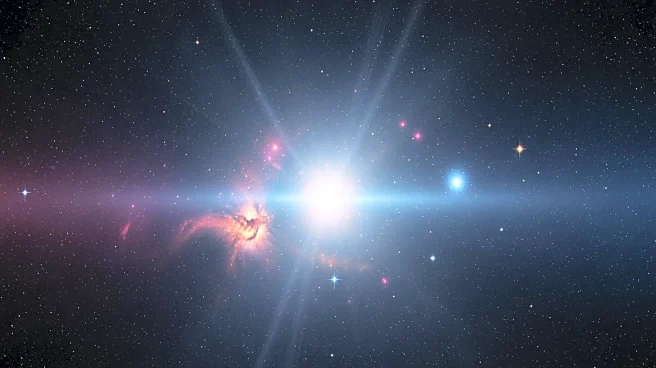
Astronomers using the James Webb Space Telescope (JWST) have potentially discovered the most distant supernova ever observed, occurring when the universe was just 730 million years old. This discovery was made while studying a gamma-ray burst, GRB 250314A,
which was detected by the Space Variable Objects Monitor. The burst, lasting around 10 seconds, suggested a long-duration gamma-ray burst typically associated with supernovae. Researchers found evidence that the burst was produced by an exploding star at the universe's edge, confirming predictions about JWST's capabilities. This event provides a rare opportunity to study the evolution of early-universe stars and galaxies, as such high-energy events are seldom observed within the first billion years of the universe.
Why It's Important?
The discovery of such an early supernova is significant as it offers insights into the nature of stars in the early universe, which may have had more massive cores than those today. Understanding these early stars is crucial for comprehending the formation and evolution of galaxies. The findings also demonstrate the JWST's ability to observe individual exploding stars at extreme distances, enhancing our understanding of cosmic history. This could lead to a better grasp of the universe's expansion and the role of dark matter and energy in shaping cosmic structures.
What's Next?
Researchers plan to conduct follow-up observations to confirm the supernova's characteristics and separate the light contributions from the supernova, afterglow, and host galaxy. These observations will help refine our understanding of early-universe stellar populations and the conditions that led to such massive stellar explosions. The continued study of these phenomena could provide further insights into the universe's formative years and the processes driving its expansion.