





What's Happening?
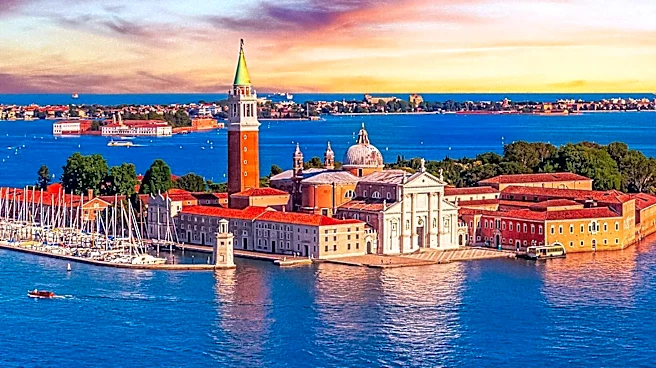
Researchers have proposed a range of solutions, including the potential relocation of the city, to protect Venice, Italy, from the escalating threat of climate change and rising sea levels. The historic city, known for its intricate canal system, has
experienced increased flooding over the past 150 years. A paper published in Scientific Reports highlights that 18 of the 28 major flooding events, where at least 60% of the city was impacted, have occurred in the last century. Piero Lionello, a professor of atmospheric physics and oceanography at the University of Salento and lead author of the paper, noted a significant increase in flooding over the last three decades. While Venice currently utilizes the MOSE project, a system of mobile flood barriers, experts warn that these will become inadequate as sea levels continue to rise. The MOSE barriers were activated 31 times between October 2023 and April 2024 to prevent water from the Adriatic Sea from entering the lagoon. However, projections indicate that existing defenses may only be effective until sea levels rise by 1.25 meters, a benchmark expected to be surpassed by 2300 even under low-emissions scenarios.
Why It's Important?
The situation in Venice underscores the severe global impact of climate change on historic urban centers and cultural heritage sites. The proposed solutions, ranging from ring dikes costing billions to a 'super levee' exceeding $35 billion, and even the relocation of the city at an estimated cost of up to $118 billion, highlight the immense economic and logistical challenges posed by rising sea levels. The potential loss or drastic alteration of Venice would represent a significant blow to global tourism and cultural preservation. The city's unique lagoon ecosystem is experiencing a relative sea level rise of approximately 2.5 millimeters per year, exacerbating the problem. The increasing frequency of high tides, with 76 events exceeding 1.1 meters between 2015 and 2024 compared to 30 between 1870 and 1949, demonstrates the accelerating nature of the threat. This situation serves as a critical case study for other coastal cities worldwide facing similar environmental pressures, emphasizing the urgent need for long-term climate adaptation strategies.
What's Next?
Climate experts are advocating for immediate long-term planning to safeguard Venice from rising sea levels over the coming centuries. The proposed solutions require decades for construction, emphasizing the urgency of initiating these projects. Researchers suggest that ring dikes, which would involve constructing walls around the city to separate it from the lagoon, might be necessary to protect Venice's city center. Beyond a 4.5-meter sea level rise, projected to occur after 2300 under high emissions scenarios, the relocation of the city's residents and historic landmarks inland may become unavoidable. This 'provocative' solution would involve physically moving individual buildings and monuments. The ongoing performance of the MOSE barrier system will be closely monitored, but its eventual inadequacy necessitates the exploration and implementation of more robust, long-term interventions. International cooperation and significant financial investment will be crucial in determining the future of Venice.
Beyond the Headlines
The existential threat to Venice extends beyond immediate flooding concerns, touching upon profound ethical, cultural, and societal implications. The idea of relocating an entire historic city, with its unique architectural heritage and centuries-old way of life, raises complex questions about preservation versus adaptation. Such a move would fundamentally alter the identity of Venice, transforming it into a 'completely different Venice' as noted by Professor Lionello. The economic burden of these interventions also highlights the global disparity in resources available for climate adaptation, as many other vulnerable coastal communities may lack the means to implement similar large-scale projects. Furthermore, the situation in Venice underscores the broader debate on whether to invest in monumental engineering solutions or to consider more radical, transformative approaches to living with a changing climate. The city's fate could set a precedent for how humanity confronts the irreversible impacts of climate change on its most cherished cultural sites.