
What's Happening?
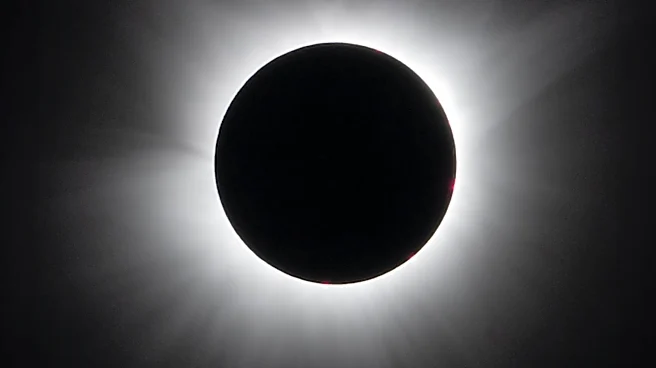
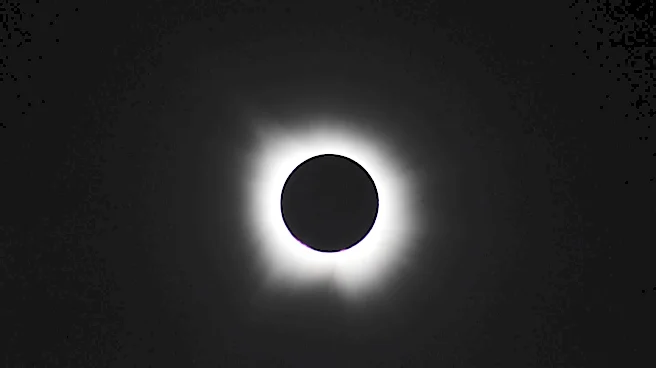
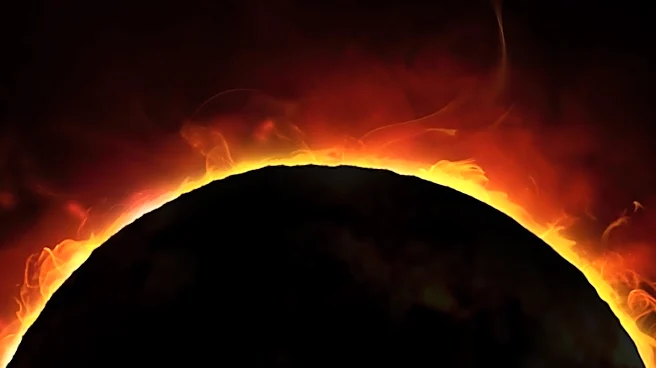
NASA is gearing up for a total solar eclipse occurring on August 12, which will be visible in parts of Greenland, Iceland, northern Russia, the Atlantic Ocean, Spain, and a small corner of Portugal. The
agency plans to stream the event live, providing views across the path of totality and interviews with experts. During the eclipse, NASA will conduct several experiments, including using a WB-57 high-altitude research aircraft to study the Sun's corona. Additionally, the Nationwide Eclipse Ballooning Project, supported by NASA, will involve students from various U.S. universities launching scientific balloons in Iceland and Spain to examine the eclipse's impact on Earth's atmosphere.
Why It's Important?
The total solar eclipse presents a unique opportunity for scientific research, particularly in understanding the dynamics of the Sun's corona. The experiments conducted by NASA could provide valuable insights into solar phenomena and their effects on Earth's atmosphere. This event also serves as an educational platform, engaging students in hands-on scientific research and fostering interest in STEM fields. The widespread visibility of the eclipse across the Northern Hemisphere, including parts of the U.S., Canada, and Europe, allows for broad public engagement and awareness of astronomical events.
What's Next?
Following the eclipse, NASA will analyze the data collected from the experiments to enhance understanding of solar and atmospheric sciences. The agency will also share findings with the scientific community and the public, contributing to ongoing research in space and atmospheric sciences. The success of the Nationwide Eclipse Ballooning Project may lead to similar educational initiatives in future astronomical events, promoting further collaboration between NASA and educational institutions.