
What's Happening?
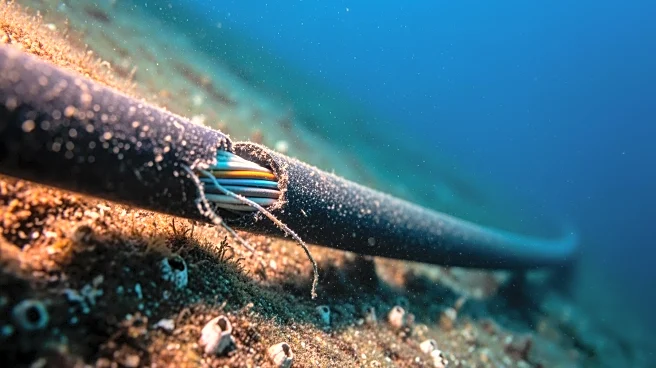
A sixth subsea cable in the Baltic Sea has been damaged, prompting investigations by regional authorities who are concerned about potential sabotage. The incident occurred near a landing station in Liepaja,
Latvia, after a vessel named Fitburg, which had departed from St Petersburg and was en route to Haifa, Israel, crossed the cable. The extent of the damage has not been disclosed, and it remains unclear whether the damage was intentional. Latvian Prime Minister Evika Siliņa stated that crisis management officials and law enforcement are working to determine the cause. Additionally, Estonia reported faults on two subsea cables linking it to Sweden and another connecting the mainland to the island of Hiiumaa.
Why It's Important?
The damage to the subsea cable raises significant concerns about the security and stability of critical infrastructure in the Baltic Sea region. Such incidents can disrupt communication and data transfer, impacting both local and international operations. The potential involvement of Russian-linked maritime activity adds a geopolitical dimension, heightening tensions in an already sensitive area. The investigation's outcome could influence regional security policies and international relations, particularly if sabotage is confirmed. The situation underscores the vulnerability of undersea cables, which are vital for global connectivity and economic stability.
What's Next?
Authorities are conducting technical analyses to determine the cause of the damage, with all scenarios being considered. The ongoing investigation may lead to increased security measures for subsea infrastructure in the region. If sabotage is confirmed, it could prompt diplomatic responses and potentially lead to heightened security protocols or international cooperation to protect critical infrastructure. The findings could also influence future maritime regulations and crisis management strategies.