
What's Happening?
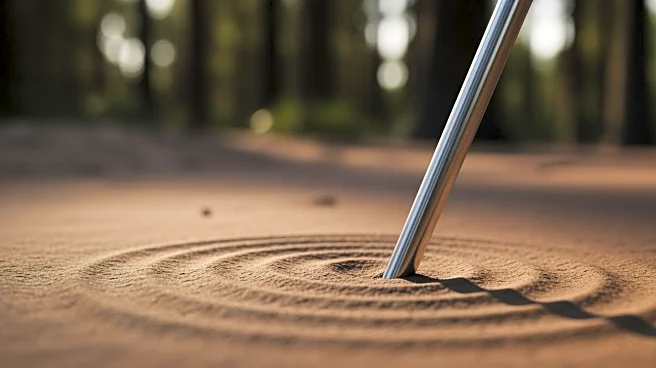
Scientists have discovered that humans possess a 'remote touch' ability, allowing them to detect objects buried in sand without direct contact. In experiments, volunteers successfully identified hidden
cubes with about 70% accuracy by perceiving faint pressure ripples in loose materials. This sense, akin to how certain shorebirds detect prey beneath wet sand, suggests that humans can perceive subtle physical signals beyond direct touch. The study, led by Elisabetta Versace at Queen Mary University of London, compared human performance with a robotic system, finding that human judgment outperformed machines in detecting these signals.
Why It's Important?
The discovery of 'remote touch' in humans could have significant implications for various fields, including archaeology, forensics, and planetary science, where detecting objects without direct contact is crucial. This ability could enhance precision and safety in fieldwork, reducing accidental damage during excavations. The findings also suggest potential advancements in robotic technology, as understanding human sensory capabilities could inform the development of more sensitive and accurate robotic sensors. This research highlights the untapped potential of human sensory perception and its applications in technology and science.
What's Next?
Future research will likely explore the application of 'remote touch' in different granular media, such as soil or plastic beads, to understand how various factors affect detection capabilities. Enhancing robotic training to improve precision and reduce false positives is another area of focus. Additionally, training humans to sharpen their ability to detect weak cues could benefit professionals in fields requiring precise tactile feedback, such as surgery or rescue operations. The study opens new avenues for exploring human sensory capabilities and their technological applications.